There are cities you explore by looking up. Naples is also discovered by looking beneath your feet.
For several days, I deliberately lose myself in the narrow streets of the historic center. I learn to tame the joyful Neapolitan chaos: scooters appearing out of nowhere, balconies overflowing with laundry, pizzas coming out of ovens at every hour of the day, and locals chatting from one window to another as if the entire street were part of the same house.
Then one day, I decide to leave all that commotion behind… and descend forty meters underground.
And I have no idea that this visit is about to become one of the most surprising experiences of my stay.
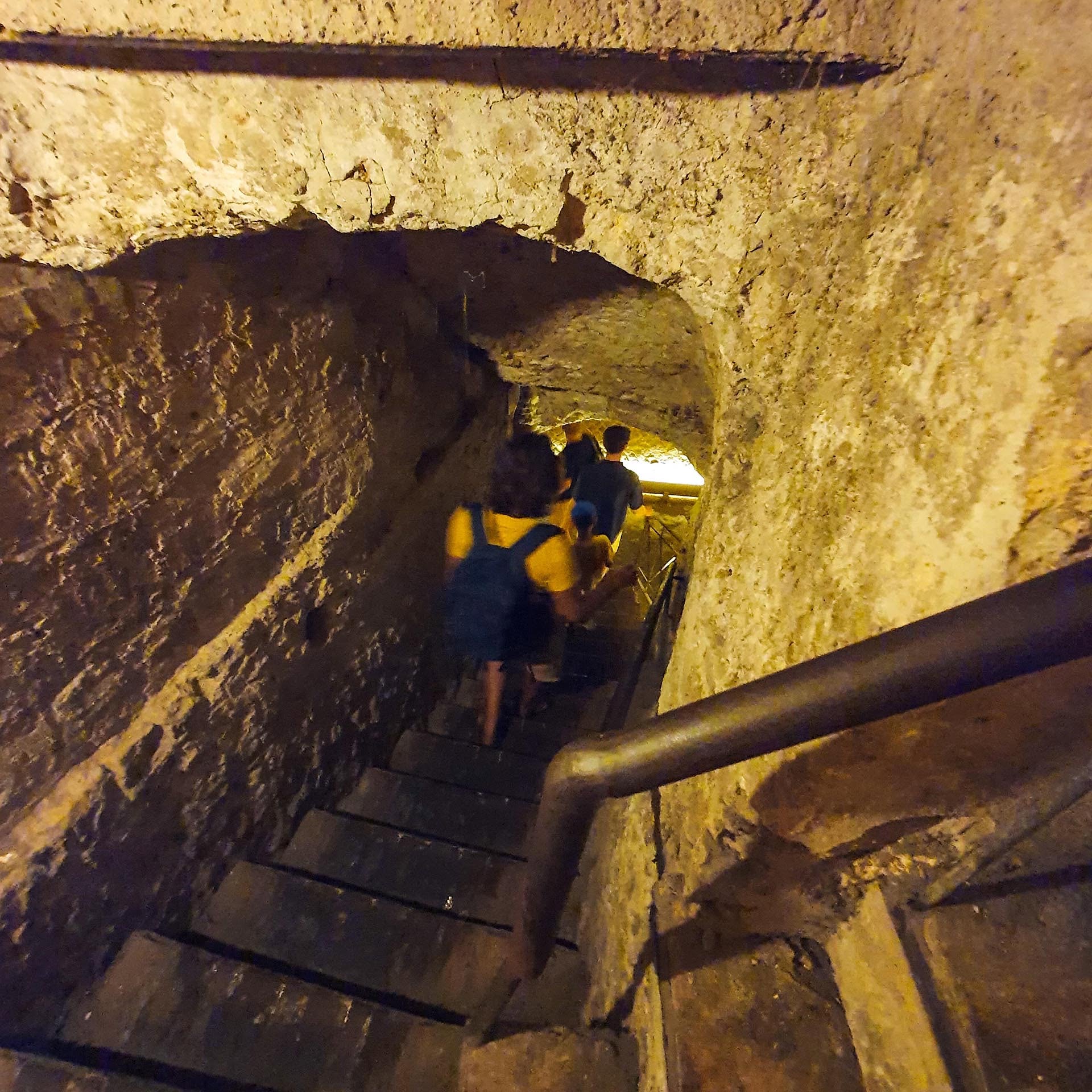
As soon as I start walking down the first steps, the temperature drops instantly. With each landing, the air becomes a little cooler. The noise of the city slowly fades away, until all that remains is an almost unreal silence.
Just a few minutes earlier, I was standing in the middle of Naples’ glorious chaos. Now, I am entering another world.
A hidden city beneath the city
The entrance to the underground tunnels is discreetly tucked away on Piazza San Gaetano, right next to the famous Sorbillo pizzeria. If you do not know it is there, you could easily walk past without noticing it.
When I arrive, I am told that the next tour in English is scheduled for 2 p.m. Tours run approximately every two hours between 10 a.m. and 6 p.m.
But waiting three hours? Absolutely not.
Since I understand enough Italian, I eventually decide to join the 11 a.m. Italian group straight away. And honestly, even though I do not catch every single detail, I do not regret my decision for a second.
The ticket (€10 at the time of my visit) is paid directly at the entrance before beginning the descent.
About a hundred steps later, there we are, almost forty meters below the surface. And this is only the beginning.
Walking through more than two thousand years of history
What fascinates me immediately is that these underground passages never had just one purpose. Originally, the Greeks and later the Romans extracted the stone from here that would be used to build Naples. Later on, these vast galleries became aqueducts, supplying the entire city with water.
During the Second World War, they served as air-raid shelters for thousands of residents who came down here to take refuge during the bombings. Then, after the war, part of the tunnel system was used as a dump.
So in the space of just a few hundred meters, you travel through several thousand years of history. Every era has left its mark on the walls. You can see the different types of stone, the evolving construction techniques, the repairs, the scars of time.
You are not simply visiting a cave. You are visiting the very foundations of Naples.
The passages where it is better not to be claustrophobic
At first, the galleries are relatively wide. Then the guide hands us a candle… and that is when I immediately understand that something is about to happen.
We enter a passage so narrow that, at times, you have to turn your shoulders sideways to move forward. In some places, the two walls seem determined to meet. The electric light disappears completely, leaving only the flickering flame of our candles.
Every tiny step is announced from person to person. “Careful… one step…” “Small hole…” “It goes down…” The whole group moves slowly through the almost total darkness.
I am not particularly claustrophobic, but I understand why some people choose to wait for the rest of the group before this part of the visit.
And I have a thought that makes me smile to myself. I genuinely wonder how the guides explain this section to very large-bodied visitors before the tour begins. Because there are clearly places where… you simply would not get through.
Surprisingly, the website does not mention this very narrow section at all. So if you are claustrophobic, please take this information seriously.
Incredibly clear water
After these oppressive corridors, we arrive in front of one of the old water reservoirs.
The reward is immediate. The water is perfectly transparent. Still. You can see the bottom with astonishing clarity. The walls reflect on the surface like a mirror. It is then that you truly understand the ingenuity of the aqueduct network that once supplied the entire city.
In another section, the guide also shows us an experiment being carried out underground: vegetables and various plants are being grown without natural light, in order to study their development using only the constant humidity of the tunnels.
On paper, the idea sounds promising. In reality… the plants seem to be surviving more than living.
Traces of the war
As the visit continues, several objects also remind us of the essential role these galleries played during the bombings. We see, among other things, a bomb found in the underground tunnels, as well as various everyday objects used by the families who came here to take shelter during air-raid warnings.
I try to imagine several hundred people living here for hours, sometimes for days, far from sunlight. The contrast is striking.
Today, we visit this place out of curiosity. Back then, people came down here to survive.
A house hiding an incredible secret
I think the tour is over. I am wrong. The guide takes us a few streets away, into a small house that looks like all the others.
Well… almost.
At first glance, it is just a simple one-room apartment. Then our guide pushes the bed. Yes… the bed. It slides along a rail and reveals a secret staircase.
I immediately feel as if I have stepped into a film, or rediscovered an old childhood dream: finding a secret passage hidden behind a piece of furniture.
We descend underground once again. We learn that the owner once used this space for an illegal activity. But long before that, these rooms were actually part of an ancient Greek theatre.
Behind the scenes of a theatre more than two thousand years old
As we move beneath the foundations of today’s buildings, we gradually discover different layers of stone corresponding to the successive eras of Naples.
The guide explains that we are probably walking behind the stage of the ancient theatre, where performers would have prepared before making their entrance.
The ceiling is extremely low, and for good reason. Just above our heads… someone is quite simply living their everyday life.
At one point, we can even glimpse a modern kitchen through an opening. The idea is completely wild: beneath an entirely ordinary Neapolitan apartment, the remains of a theatre more than two thousand years old are still hiding.
Naples, decidedly, never stops surprising me.
Returning to the surface
When we finally climb the stairs back up, the heat outside hits us full force.
Just a few minutes earlier, I was almost shivering underground, and now I am back among the honking horns, the scooters, the voices echoing between buildings, and the laundry hanging from the windows. As if nothing had happened.
And yet…
I now know that another Naples continues to exist just beneath my feet, invisible, silent, and incredibly fascinating.
If you love understanding a city rather than simply visiting it, do not miss Naples Underground. This is not just a historical visit. It is a dive into all the lives this city has known, from Antiquity to today. And personally, it is one of the experiences that surprised me the most during my stay.