I’ve been travelling full-time since 2014. So, after more than ten years on the road, I’ve had plenty of time to watch countries change. And that’s normal.
The world evolves. Cities evolve. Tourism evolves. Standards of living rise, infrastructure develops, certain neighbourhoods become more popular, and wages and costs increase too.
The places I discovered ten or twelve years ago had already changed enormously compared with what they had been twenty years earlier.
So obviously, I don’t expect to find 2014 prices in 2026. That would be completely absurd.
But evolution doesn’t necessarily mean sending prices through the roof without improving what you’re actually selling.
And for the past three or four years, there’s one thing that has seriously started to get on my nerves when I travel: in some destinations, the relationship between the price of accommodation and what you actually get for your money has become completely ridiculous.
More than ten years ago, I could travel through certain countries and get a room for $8.
For $8, obviously, I wasn’t expecting the Ritz.
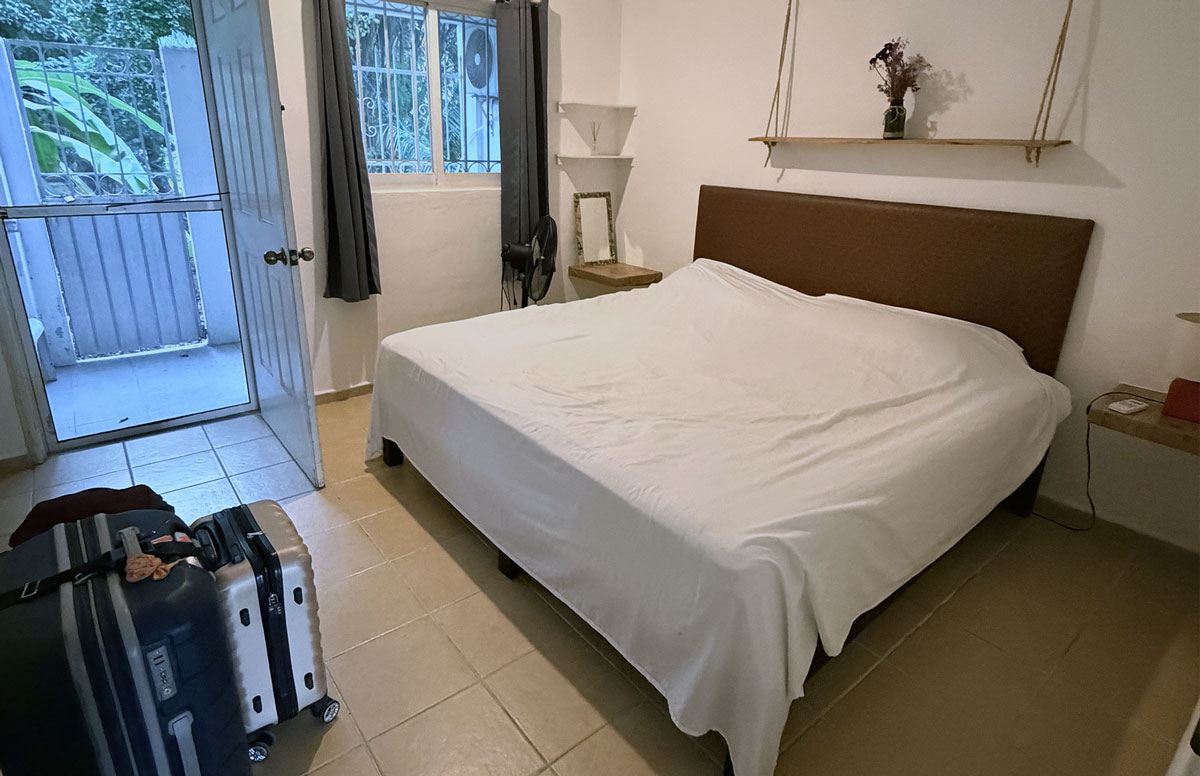
Sometimes it was basically four wooden planks, a bed, no air conditioning, a shared bathroom, not much in the way of hot water, and a window that was more of an architectural concept than an actual window.
But it cost $8. Fair enough.
Today, I can find almost the exact same room for $35.
The problem isn’t that an $8 room has gone up to $10, $12 or even $15 over ten years. I can completely understand that.
The problem is asking me to pay $35, $50 or $80 for four wooden planks that are sometimes literally the same four wooden planks that were there ten years ago.
No more hot water, no better insulation, still no decent air conditioning, still a questionable bathroom, still damp, and in some cases, still no window.
The price has gone business class. The comfort is still waiting at the departure gate.
And recently, I reached a truly spectacular level of absurdity.
The other day, I was looking for accommodation in Cartagena, Colombia. I was already there in 2021, so it really wasn’t that long ago.
I came across a room in a hostel. Not a five-star hotel overlooking the Caribbean. A hostel.
No private bathroom, no private toilet, no window, under the roof, with everything else that normally comes with staying in a hostel: shared spaces, people coming and going, noise, crowds…
The price for one month?
Around €7,000.
Seven. Thousand. Euros. 😰
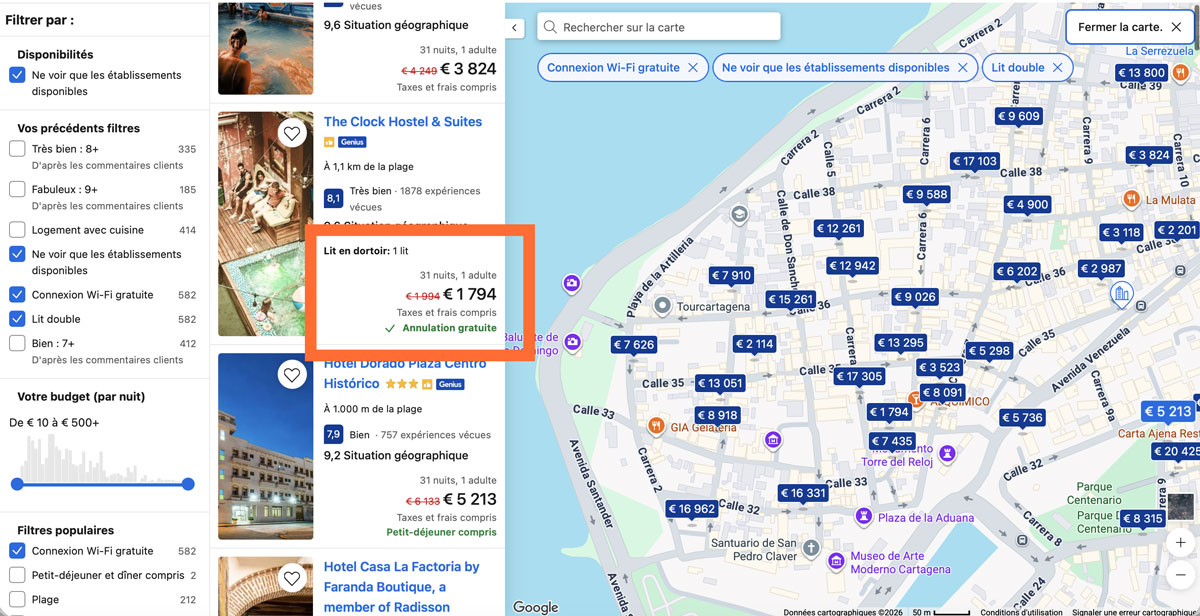
At this point, it’s not even inflation anymore. It’s a social experiment to see how far someone can be pushed before they start insulting their computer.
And unfortunately, this isn’t a completely isolated example.
I now regularly come across extremely basic accommodation in countries with a relatively low cost of living being offered at prices equivalent to — or even higher than — what I can pay in much more developed countries.
I’m currently in Canada, and some of the accommodation I’ve been looking at for my next destinations costs significantly more than what I’m paying here.
Except here, I have hot water. Good internet. A proper kitchen. Decent insulation. Windows. Appliances that work.
And I’m not exactly looking for “luxury”.
So yes, it started to annoy me. And whenever something really annoys me, I want to understand why.
Because I’ve always believed that once you understand a phenomenon better, you can decide whether to accept it, adapt to it… or figure out how to work around it.
And after digging into it, I realised something important: The price of tourist accommodation is no longer necessarily connected to the standard of living in the country where it’s located.
And that changes everything.
In the past, a cheaper country usually meant cheaper travel
For a long time, the logic was fairly straightforward.
Wages were lower in a country, property was cheaper, operating costs were lower, and therefore accommodation was cheaper too.
Of course, the quality and comfort could be lower. That was the deal. And personally, I loved it.
If I was paying $10 or $20 for a room in Asia or Latin America, I wasn’t going to complain because my shower had about as much pressure as a plant mister. Quite the opposite.
The value for money still made sense. And that’s precisely what has broken down in certain destinations.
Today, the price of tourist accommodation can be much less connected to local costs and much more connected to the maximum amount the target tourist market is willing to pay.
Which brings us to something particularly important.
When we say “international tourists”, we’re not really talking about everyone
You could summarise the phenomenon by saying that prices have adapted to the purchasing power of international tourists.
Except that’s not entirely true.
A French woman, a Spanish woman, an Argentinian woman, a Brazilian woman, a Canadian woman and an American woman are all international tourists.
They absolutely do not have the same purchasing power.
In many destinations across Latin America and the Caribbean, the benchmark is increasingly the international clientele with the deepest pockets.
And very often, that clientele is American.
Cartagena is a perfect example.
In 2024, the city welcomed around 856,000 international visitors, a huge increase compared with 2021. Of those, approximately 276,000 came from the United States.
Americans therefore represented almost one-third of Cartagena’s international visitors and were, by a very wide margin, its largest international market.
And that changes the way accommodation can be priced.
A property owner doesn’t need every traveller in the world to be able to afford a $150 room. They simply need enough people who are willing to pay $150 to fill the property.
Imagine a destination has 1,000 available rooms and 50,000 people would like to visit.
If 1,000 of those people are willing to pay $200 a night, economically speaking, it doesn’t really matter that the other 49,000 think the price is completely insane.
The rooms can still be sold.
And this is where the market starts excluding a whole section of international travellers who, by any normal definition, can actually afford to travel.
The American benchmark completely changes how prices are perceived
Take an American tourist considering four days in Cartagena.
She isn’t necessarily asking herself:
“How much should a decent room in Colombia cost considering local salaries, property prices and the level of comfort being offered?”
She may simply be thinking:
“How much would four days in Miami cost me?”
If she’s used to seeing hotel rooms for $250 or $300 a night in the US, a room in Colombia for $120 might look like a bargain.
Even if that room objectively offers far less comfort.
And that’s where the system becomes particularly frustrating for travellers from other countries.
Because tourist prices can become Americanised without French, Spanish, Argentinian or Colombian salaries becoming American.
An accommodation can physically be in Colombia, employ staff who are paid in Colombian pesos and offer a relatively basic Colombian standard of comfort… while effectively being priced according to an international benchmark mentally calculated in US dollars.
Welcome to globalisation — but apparently only when it’s time to get your credit card out.
Airbnb and booking platforms have also changed the rules
Then there’s a much more technical phenomenon: dynamic pricing.
The price of a room is no longer necessarily determined the old-fashioned way: “My costs are X, I want to earn Y, therefore my room should cost Z.”
Today, prices can be adjusted according to demand, dates, seasons, events, occupancy rates and what nearby properties are charging.
Airbnb, for example, offers its Smart Pricing system, which automatically adjusts prices based on hundreds of factors related to the property and local demand.
The platform also gives hosts pricing recommendations based on factors such as location, amenities, previous bookings and recent prices for comparable properties nearby.
In 2026, Airbnb further strengthened its tools allowing hosts to adapt their prices according to seasons and local demand.
And there’s nothing inherently wrong with the principle. A hotel in Nice has always been more expensive in August than in November, long before Airbnb existed.
The problem starts when an entire market begins pricing itself through comparison.
My neighbour is charging 100.
So I can probably charge 110.
It gets booked?
The property next door goes up to 120.
People are still booking?
Let’s try 140.
Little by little, the new benchmark for the neighbourhood becomes 140.
And nobody has installed a new window in the meantime.
The platforms themselves encourage hosts to compare their listings with similar properties and regularly adjust their prices.
Airbnb even explains that the price of a listing compared with other available properties in the area affects its visibility in search results.
So the question is no longer simply: What is this product worth?
The question becomes: What is the maximum amount the market is willing to pay for it?
Those are two very different things.
Covid accelerated something that was already happening
Then 2020 happened.
For a while, international tourism virtually stopped. And when it came back, it didn’t simply return to the way it had worked before.
Remote work had become mainstream.
Tens of thousands of people had discovered that they could work from Mexico City, Medellín, Lisbon, Bali or Playa del Carmen instead of from their apartment in New York, Toronto or London.
Long-term travel suddenly became much more accessible to a population that previously had high incomes but needed to remain physically close to their workplace.
For property owners, this was an extraordinary new market: people earning salaries from wealthy countries while living in countries where local costs were much lower.
And inevitably, the market adapted.
Not necessarily to local residents. Not necessarily to European travellers. But to the people who could afford to pay more.
And what about the quality?
This is probably the part that annoys me the most.
Because if prices had tripled and the standard of accommodation had also tripled, this article probably wouldn’t exist.
If my $8 room from ten years ago now costs $35 but comes with an excellent mattress, proper insulation, a private bathroom, hot water, quiet air conditioning and flawless internet… personally, I’d still think it was a shame, but fair enough. At least the product would have evolved.
But that’s not always what I’m seeing.
In many of the places I return to, the buildings and overall standard of comfort have improved far less than the prices have.
Still damp — sometimes even worse. Still no insulation. Still that air conditioner that sounds like a Boeing 747 before dying at 3 a.m. Still rooms with no natural light. Still bathrooms where taking a shower turns the entire room into a municipal swimming pool.
And we haven’t even mentioned safety and everything else.
Except now it’s $80.
That disconnect is what sometimes makes you feel like you’re being completely ripped off.
It’s not: “Things cost more than they used to.” Of course things cost more than they used to.
It’s: “Why does this thing now cost four times as much when the thing itself is still exactly as mediocre as it was before?”
There are still legitimate reasons why prices have increased
It would also be far too easy to blame everything on American tourists, Airbnb or property owners suddenly becoming greedy.
Accommodation providers have also been affected by inflation.
Electricity costs more. Materials cost more. Maintenance costs more. Wages have increased in many countries. Insurance, taxes, food and construction costs have risen too.
Obviously, a room cannot stay at its 2014 price forever.
And thankfully, some local wages have increased over the past twelve years.
But those factors explain gradual increases.
They’re much less convincing when trying to explain spectacular price increases without an equivalent improvement in the product.
So we need to distinguish between normal inflation and the tourist revaluation of a destination.
They’re two different phenomena.
The country itself isn’t necessarily expensive. The tourist bubble is.
This is probably the most useful distinction I found while researching all of this.
When I say: “Mexico has become expensive.” That isn’t entirely accurate.
Huge parts of Mexico cost absolutely nothing like Tulum, certain neighbourhoods in Mexico City or Playa del Carmen.
The same applies to Colombia.
It isn’t necessarily the country itself that has become outrageously expensive.
Sometimes, it’s a small parallel economy that has developed around international tourism. And that economy can operate according to its own prices.
That’s why you can leave a tourist neighbourhood, eat in a restaurant mainly frequented by locals and pay just a few euros for your meal… then walk ten minutes back to your tourist accommodation and pay €120 for the night.
Both prices exist simultaneously within the same economy.
One is primarily determined by local purchasing power. The other by international tourist purchasing power.
Twelve years of travel have also given me one disadvantage: I know what things used to cost
There’s also something very personal behind my frustration.
I have history.
Someone visiting Cartagena for the first time today and finding a room for $100 has no other reference point.
Cartagena costs $100. That’s it.
I sometimes look at exactly the same kind of place and think: “Hang on…”
I remember what I paid in Peru. In Mexico. In Colombia. In Thailand.
More importantly, I remember what I got for my money.
It’s a bit like going back to your favourite little restaurant ten years later and discovering that the dish has gone from €8 to €32.
That increase could be completely justified.
But if the plate still contains exactly the same overcooked pasta and the chairs are still the same plastic ones from 2004, you’re probably going to have a couple of questions.
So, has travelling become too expensive?
No.
I think our old mental map of cheap travel has simply become outdated.
“Latin America = cheap.”
“Asia = cheap.”
“Europe and North America = expensive.”
That works less and less.
Today, a destination in a country with a relatively low standard of living can develop a huge international tourist bubble and offer absolutely terrible value for money.
At the same time, I can sometimes find comfortable monthly accommodation in a supposedly expensive country that actually costs me less.
So we need to stop comparing countries alone.
We need to compare the actual price with the actual comfort, in a specific city, at a specific time of year.
And especially for someone like me, who regularly stays somewhere for several weeks or months, it probably means looking beyond the destinations that have become the stars of Instagram, TikTok and every “best cities for digital nomads” ranking.
Which, I have to admit, is a little sad sometimes.
Understanding all of this still doesn’t make my €7,000 room any more appealing
Don’t worry.
After doing all this research, I’m still not looking at my windowless hostel room in Cartagena thinking: “Aaaah, now that I understand the economic mechanisms behind it, €7,000 — what a bargain!”
No.
I still think it’s completely ridiculous.
But at least I understand why I’m coming across these kinds of absurdities more and more often.
And more importantly, it’s changing the way I choose my next destinations.
For a long time, I could choose certain countries knowing almost automatically that the cost of living there would be lower than in Europe or North America.
Today, that’s no longer a given.
I pay much more attention to the actual value for money in a city, how exposed it is to international tourism, the season I’m travelling in, the neighbourhoods where locals actually live, and alternatives to the major booking platforms.
Because ultimately, the real question is no longer: “Which country has the lowest cost of living?”
It’s: “Where can my money still buy me a good quality of life?”
And those are absolutely not the same thing.
So I’ll keep travelling. I’ll keep returning to countries I love, even when they’ve changed. And I’ll keep accepting that I have to pay more than I did in 2014, because it’s 2026 and that’s completely normal.
But $35 for my four wooden planks with no hot water?
I think I’ll keep looking.