Some cities let you approach them gently, with freshly scrubbed façades, orderly squares and cafés where everything seems designed to please travellers. Naples does not pretend. It arrives all at once: loud, alive, a little dishevelled, with scooters brushing past pavements, sheets hanging between buildings, voices rising from narrow lanes and that warm smell of pizza dough, strong coffee and sea air drifting somewhere between the walls.
From the train, leaving Rome behind, it almost feels as though you are slipping into another Italy. A rawer Italy, more direct, more working-class too. Naples does not try to be perfect, and that is probably what makes it so endearing. It has edges, cracks, tired staircases, façades eaten away by time, but also an incredible energy, a generosity of the streets, a beauty that appears exactly where you least expect it.
In the distance, Mount Vesuvius watches over the city. Its dark silhouette rises above the Bay of Naples like an ancient presence, almost calm, even though you know what it carries inside. This still-active volcano, responsible for the destruction of Pompeii and Herculaneum in AD 79, gives Naples a particular depth. Here, history is never far away. It is beneath your feet, in the stones, in the underground tunnels, in the churches, in the museums, in the recipes, in the gestures of the people who continue to live among all this accumulated memory.
Naples is not a city you visit only with a map. You move through it with your senses. You have to agree to get lost in its historic centre, to slow down in front of a small chapel wedged between two shops, to listen to conversations bursting from windows, to follow the smell of frying oil to a tiny counter, to look up at a balcony covered in plants, laundry and life. It is an enormous city, sometimes disorienting, sometimes tiring, but rarely lukewarm. It asks for a little surrender, and it rewards those who do not try to control everything.
Arriving in Naples: First impressions of a city in motion
Naples is easy to reach, especially if you are already travelling in Italy. From Rome, the train is probably the simplest option. Regional trains take longer, around three hours, but they cost less and let you watch the landscapes roll by without rushing. InterCity trains are faster, while high-speed trains connect Rome to Naples in just over an hour. So a trip to Naples from the capital is entirely possible, even if the city deserves far more than a fleeting stop.
Stepping out of Napoli Centrale, you understand immediately that Naples has no intention of welcoming you in silence. Horns answer one another, suitcases rattle over uneven pavements, passers-by always seem to know exactly where they are going, even in what looks like pure disorder. This first contact can be unsettling, especially if you arrive with a postcard version of Italy in your mind, all polished, bright and organised. Naples is bright, yes, but with a more earthly kind of light. It clings to the skin, bounces off ochre walls, slips between the closely packed buildings of the historic centre.
The city has long carried a heavy reputation, linked to the mafia and organised crime. As a traveller, that is not what you feel first. What you notice instead is the intensity of everyday life. Families talking in doorways, sellers calling out to customers, children weaving between adults, scooters appearing with an almost choreographed precision. Of course, as in many big cities, you need to keep an eye on your belongings, especially in busy places. But reducing Naples to its clichés would mean missing what gives the city its soul.
Getting lost in the historic centre
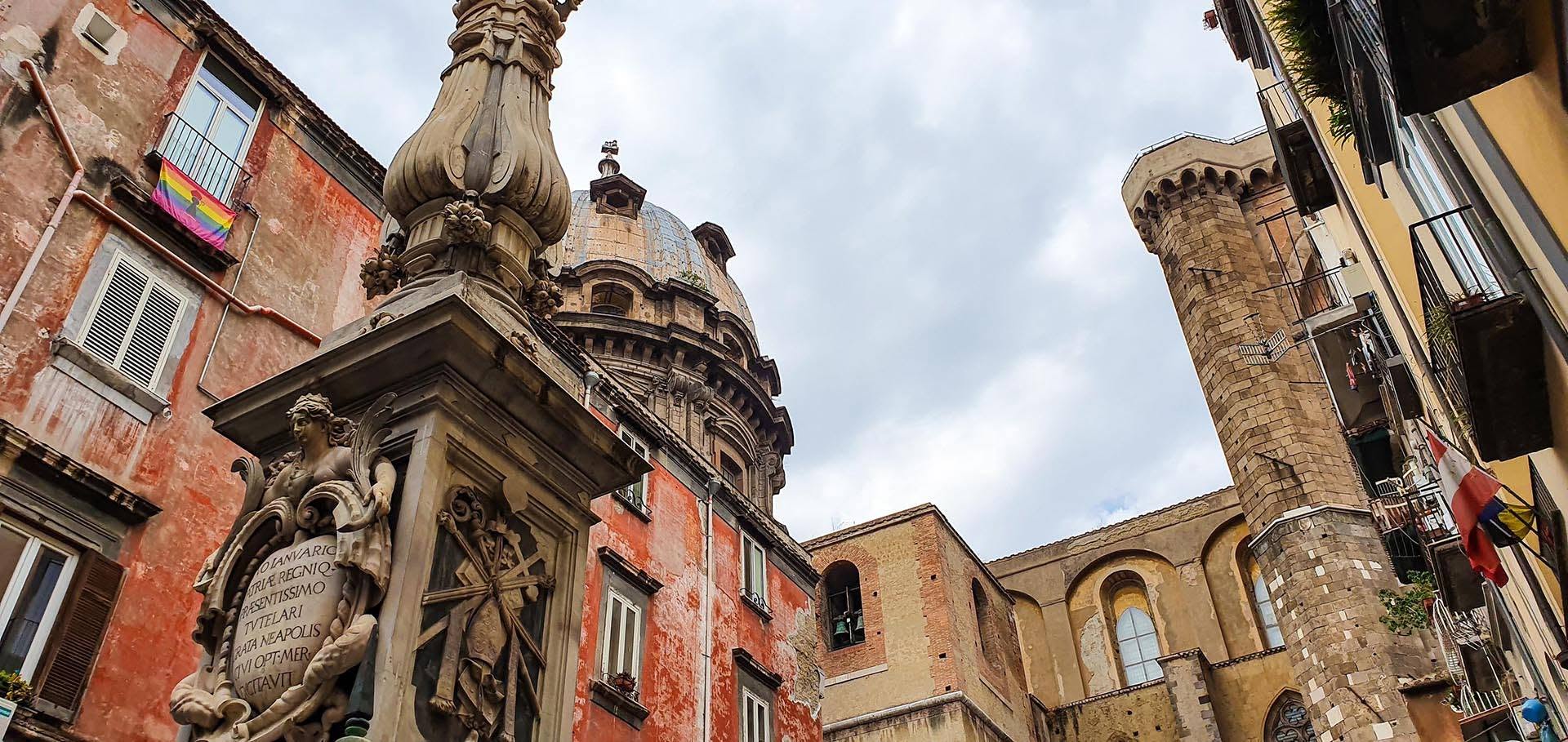
The historic centre of Naples is a labyrinth. Not a clean, decorative labyrinth, but a real, living maze, where every alley seems to hold a different scene. The walls are high, the streets narrow, sometimes so tight that the sky becomes a blue ribbon above your head. The façades carry the marks of time, with their peeling shutters, wrought-iron balconies, hanging plants and laundry drying above passers-by like a Neapolitan signature.
You walk over cobblestones worn smooth by centuries of footsteps. Scooters sometimes appear where you would have sworn no vehicle could possibly pass. Shop windows overflow with pastries, rum-glossed babà, crisp sfogliatelle and small folded pizzas eaten on the move. The cafés are tiny, often standing-room only at the counter, with an espresso swallowed in a few seconds and a conversation continuing as though it began twenty years ago.
In these streets, past and present are not separate. They live side by side without ceremony. A Baroque church appears between two souvenir shops. A small Madonna watches from a niche lit by a single bulb. A half-open door reveals a courtyard, stone staircases, weathered walls. Naples does not need to put its history behind glass: it still uses it, crosses through it, touches it every day.
You have to take time to walk along Spaccanapoli, the long artery that cuts through the historic centre like a line drawn across the city. The name literally means “Naples splitter,” and the image is perfect. As you move forward, it feels as though the street opens the city in two and reveals everything it contains: the shouts, the smells, the chapels, the bookshops, the sellers of red lucky horns, the dark façades, hurried families, slightly lost tourists and Neapolitans who, unlike everyone else, seem to move through this disorder with absolute ease.
The taste of Naples: Pizza, fried food and scalding coffee
You cannot talk about Naples without talking about pizza. It would almost be rude. Here, pizza is not just a local speciality: it is part of the landscape, part of the city’s rhythm, part of its deepest identity. Neapolitan pizza was born in working-class streets, designed as a simple, affordable, nourishing meal. And yet, when it arrives at the table, with its supple dough, puffed-up edges and tiny bubbles charred by the wood-fired oven, it feels almost ceremonial.
The dough is thin in the centre, soft around the edges, light despite its generous appearance. The mozzarella melts gently, the tomato keeps its acidity, the olive oil shines on the still-hot surface. A well-made Margherita needs nothing else. It already says so much: simplicity, precision, the heat of the fire, the taste of the ingredients.
In the street, you also find pizza fritta, more generous, more decadent, folded, golden, swollen, often filled with ricotta, provolone or salami. You eat it piping hot, with your fingers, trying not to stain yourself, which is almost impossible. Naples is not a city where you keep your elegance intact for very long, and that is perfectly fine.
Neapolitan food does not stop at pizza. The city also lives to the rhythm of its fried snacks. Cuoppo, a paper cone filled with fried fish, calamari, anchovies, croquettes or rice balls, is eaten while walking. The smell is irresistible: hot, salty, crisp, with that hint of the sea that reminds you Naples has always faced the bay.
And then there are the sweets. Sfogliatella, shaped like a shell, cracks under your teeth before revealing a fragrant cream, often made with ricotta or citrus. Rum babà is soft, soaked, glossy, sometimes topped with cream or fruit. It came from elsewhere, but Naples adopted it with such intensity that it now seems to have belonged here forever. With a Neapolitan coffee, dense and black, served in a tiny burning-hot cup, it is the perfect pause in the middle of the chaos.
Mount Vesuvius: Walking on a sleeping mountain
From Naples, Vesuvius is always pulling at your gaze. It is there, at the edge of the landscape, sometimes sharp beneath a blue sky, sometimes veiled by haze or heat. You can almost forget it is an active volcano, until the moment you decide to get closer.
The climb to the crater is not very long, around twenty to thirty minutes on foot from the main access point, but it has something particular about it. The ground changes beneath your feet. The earth becomes darker, drier, more mineral. The wind can rise suddenly, bringing an unexpected coolness after the heat of the city. As you climb, Naples recedes behind you and the bay opens below, immense, blue, almost calm.
Reaching the edge of the crater creates a strange sensation. It is not just a viewpoint. It is an encounter with a force beyond human scale. The volcano’s gaping hollow seems silent, almost asleep, but there is nothing ordinary about that silence. Inevitably, you think of the eruption of AD 79, of Pompeii, of Herculaneum, of those cities buried in a matter of hours and rediscovered centuries later. The landscape is beautiful, yes, but what makes it so powerful is the tension between the beauty of the bay, the Mediterranean light and the memory of catastrophe.
Pompeii and Herculaneum: Entering a life interrupted
Visiting Pompeii from Naples means changing scale. You leave contemporary agitation behind and enter an ancient city whose streets, houses, shops and public spaces were stopped dead by the eruption of Vesuvius. Pompeii is vast, far larger than you imagine before you arrive. You walk through paved streets where carts left their tracks, past open houses, baths, temples, an amphitheatre and frescoes that survived the burial.
What moves you most is not only the monuments, but the details of everyday life. A counter, an inscription, a courtyard, a wall painting, a room still readable. Pompeii is not an abstract ruin. It is a city where people ate, worked, loved, prayed, laughed, negotiated and waited. And that is exactly what makes the visit so powerful.
Herculaneum, smaller than Pompeii, offers a different experience, often more intimate. The town was buried under volcanic material that allowed for remarkable preservation. You can still see wooden structures, upper floors, frescoes, mosaics and houses that almost look as though they were left the day before. Where Pompeii impresses through its immensity, Herculaneum overwhelms through its closeness. You feel more of the inside of the homes, the texture of domestic life, the silence after the noise.
Visiting both sites helps you understand the shadow Vesuvius casts over the region. It is no longer just a volcano in the background of the landscape. It becomes a historical, cultural, human presence.
Going beneath Naples: The catacombs and the hidden city
Naples does not only have a visible history. It hides another one beneath its streets. Descending into the Catacombs of San Gennaro means leaving the noisy city behind and entering an underground coolness, almost still. The light drops lower, sounds become muffled, the air changes. You move through a network of galleries, tombs and crypts where thousands of Neapolitans were buried over the centuries.
The place could be frightening, and it is a little, but not only that. There is also a kind of peace in these passages carved into stone. The catacombs tell of another Naples: Christian, ancient, buried, made of rituals, beliefs and family memory. Guides often help you better understand what you are seeing, because without explanation, it would be easy to perceive only darkness and walls.
This underground world is a reminder that Naples is a city of layers. Each era has settled on top of the previous one without truly erasing it. On the surface, scooters and cafés. Below, tombs, ancient cisterns, galleries and traces of past civilisations.
The churches of Naples: Beauty, mystery and excess
Naples is a deeply religious city, but its spirituality is neither cold nor distant. It is everywhere, in grand cathedrals and small street altars, in candles, statues and eyes lifted towards protective saints. Neapolitan churches are often spectacular, sometimes dark, sometimes theatrical, heavy with marble, gilding, frescoes and legends.
The Sansevero Chapel is one of the most fascinating places in the city. It houses the famous Veiled Christ, a sculpture of almost unreal delicacy. Here, marble seems to become fabric, skin, breath. The veil laid over the body of Christ appears so delicate that it is hard to understand how such a hard material can create such an impression of transparency. You linger in front of it, not because you absolutely need to tick the visit off a list, but because the work genuinely unsettles the eye.
The chapel also preserves “anatomical machines” surrounded by strange stories, representing the human blood network with a level of detail that has fed many legends. Naples loves this mixture of beauty, science, mystery and superstition. Nothing here is ever completely simple.
The Cathedral of Naples, the Duomo, has another kind of presence. Built from the 13th century onward and transformed over the centuries, it blends several architectural styles. You can feel the weight of time, popular devotion, the city’s attachment to San Gennaro, its patron saint. In Naples, saints are not distant figures. They are part of everyday life.
Castles, sea and light on the bay
After the intensity of the historic centre, walking towards the port feels like finding space again. The air becomes saltier, the light wider. Naples opens onto its bay, with its boats, quays, cafés and silhouettes outlined at the end of the day.
Castel Nuovo, massive and elegant in its own way, stands near the port with its round towers and medieval bearing. Built in the 13th century, it recalls Naples’ political and strategic importance throughout history. From its ramparts, you can see the city, the sea, the hills, that spectacular geography that gives Naples its unique character.
Farther along, Castel dell’Ovo seems to rest at the edge of the water. An ancient fortress on an islet now connected to the city, it offers one of the most beautiful views of the port and the bay. Its name, the “Egg Castle,” comes from a legend that the poet Virgil hid a magical egg in its foundations to protect Naples. It is exactly the kind of story you enjoy hearing here, between two gusts of sea wind, because it fits the city perfectly: a mixture of stone, myth, sea and superstition.
The nearby Santa Lucia district is a pleasant place to slow down. You find cobbled streets, restaurants, cafés and people coming to enjoy the end of the day. It is a good place to sit, order something simple, watch people pass by and let Naples do what it does best: tell its own story.
The Palazzo Reale and Royal Naples
Naples is not only popular and chaotic. It has also been royal, ambitious, monumental. Piazza del Plebiscito gives a striking glimpse of that. The space is vast, almost solemn, especially after the tight lanes of the historic centre. The Palazzo Reale dominates the square with massive elegance, a witness to the time when Naples was the capital of a kingdom.
Inside, the rooms tell another story of the city: that of sovereigns, receptions, painted ceilings, grand staircases, gilding and power. The contrast is interesting. In a single day, you can move from working-class streets where pizza is eaten standing up to royal salons heavy with symbols. Naples contains all of this at once, without trying to smooth away its contradictions.
The Archaeological Museum and the secret cabinet
To understand Pompeii, Herculaneum and the ancient history of the region, the National Archaeological Museum of Naples is an essential visit. Many objects found in the buried cities are preserved here: sculptures, mosaics, frescoes and everyday items. After walking through the ruins, seeing these pieces in the museum completes the story, bringing back the colours, faces and symbols.
The museum also houses the famous Secret Cabinet, a collection of erotic art, much of it from the excavations of Pompeii. For a long time, these works were hidden from the public, considered too explicit and reserved for certain visitors or scholars. Their presence is a reminder that the Roman world had a relationship with the body, desire and representation that was very different from that of the more cautious societies that later rediscovered it. It is not necessarily a long visit, but it is revealing: history is never as well behaved as people sometimes like to present it.
Naples, a city to feel more than master
Naples is not the easiest Italian city. It can be loud, disorderly, intense. The pavements are not always practical, the traffic sometimes seems to obey invisible rules, transport can feel confusing at first, and some streets require a little awareness. But it is also a city that gives a great deal to those who agree to look at it without judging too quickly.
It gives the smell of coffee in the early morning, scorching pizzas pulled from the oven, conversations spilling out of windows, façades gilded by the light, sellers who speak with their hands, churches full of mysteries, deeply moving ancient ruins, a volcano in the distance and the sea on the horizon.
You begin to understand the Italian expression “Vedi Napoli e poi muori”: see Naples and then die. Not because Naples is the most perfect city in the world, but because it seems to have concentrated everything: beauty, fear, excess, memory, faith, hunger, noise, tenderness, the sea, dust, life.
And in the end, perhaps that is what you come to Naples looking for. Not an impeccable city. A living one.