Sometimes, all it takes is stepping a few metres away from a main street to feel as though you have entered a different city.
That morning, Caroline asked us to meet at Laurier metro station with an itinerary she had planned herself. On her sheet, the directions read almost like a small treasure hunt: Laurier, Saint-Dominique, Saint-Joseph, De Bullion, Demers, Villeneuve, Gilford… then a string of alleys to enter, leave, and pick up again a few blocks later. Some have names, others are simply defined by the streets they run between. There will be Modigliani Alley, Cachalot Alley, Pirate Alley, and plenty of unnamed ones that turn out to be just as interesting.
At first glance, though, our playground looks fairly ordinary.
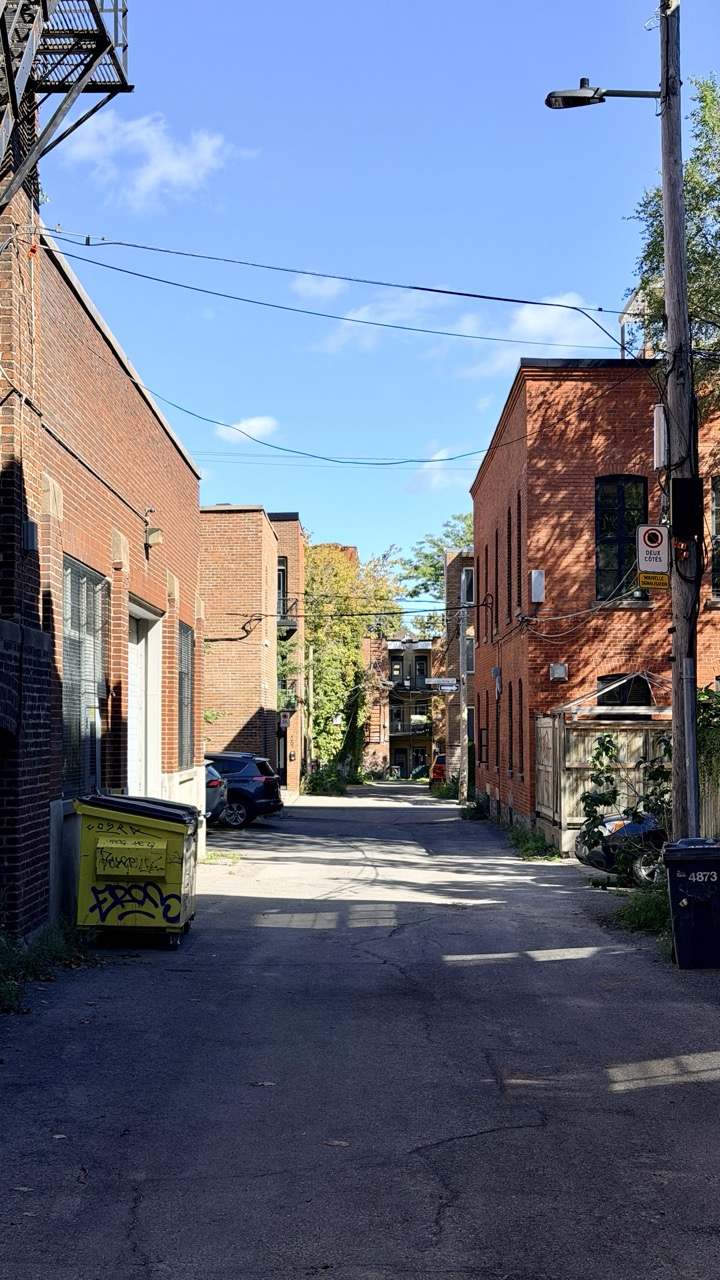
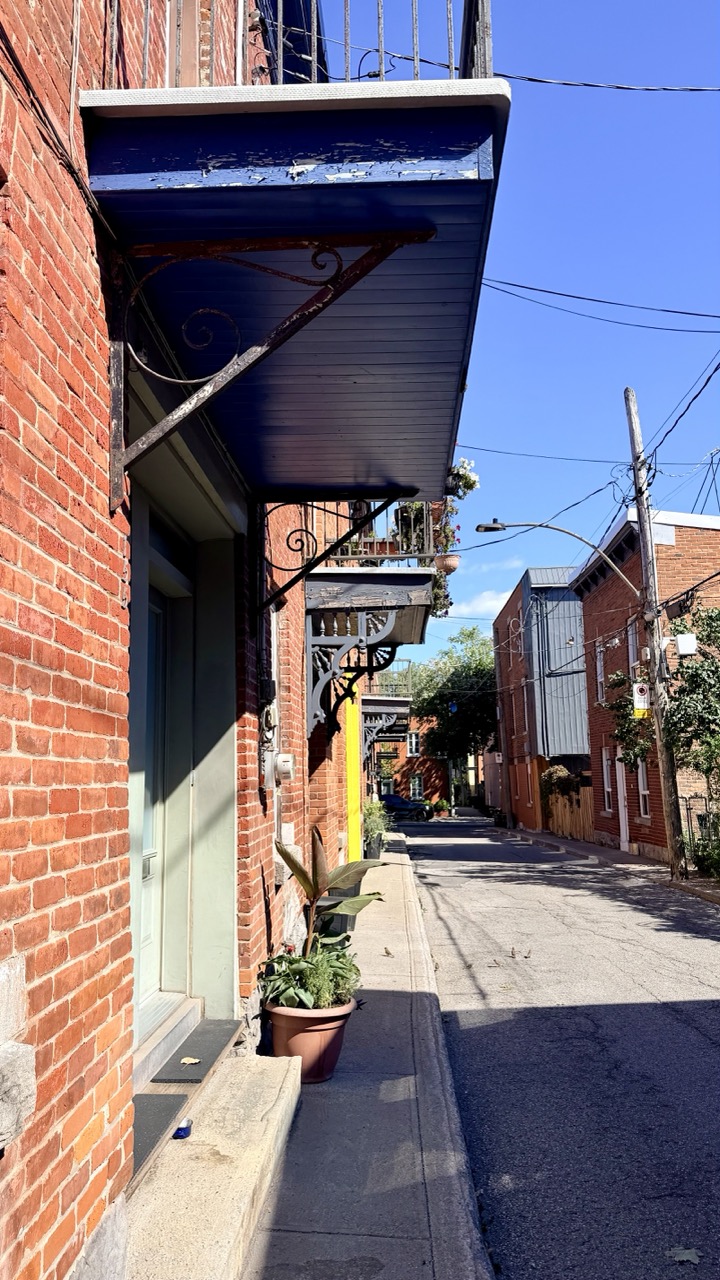
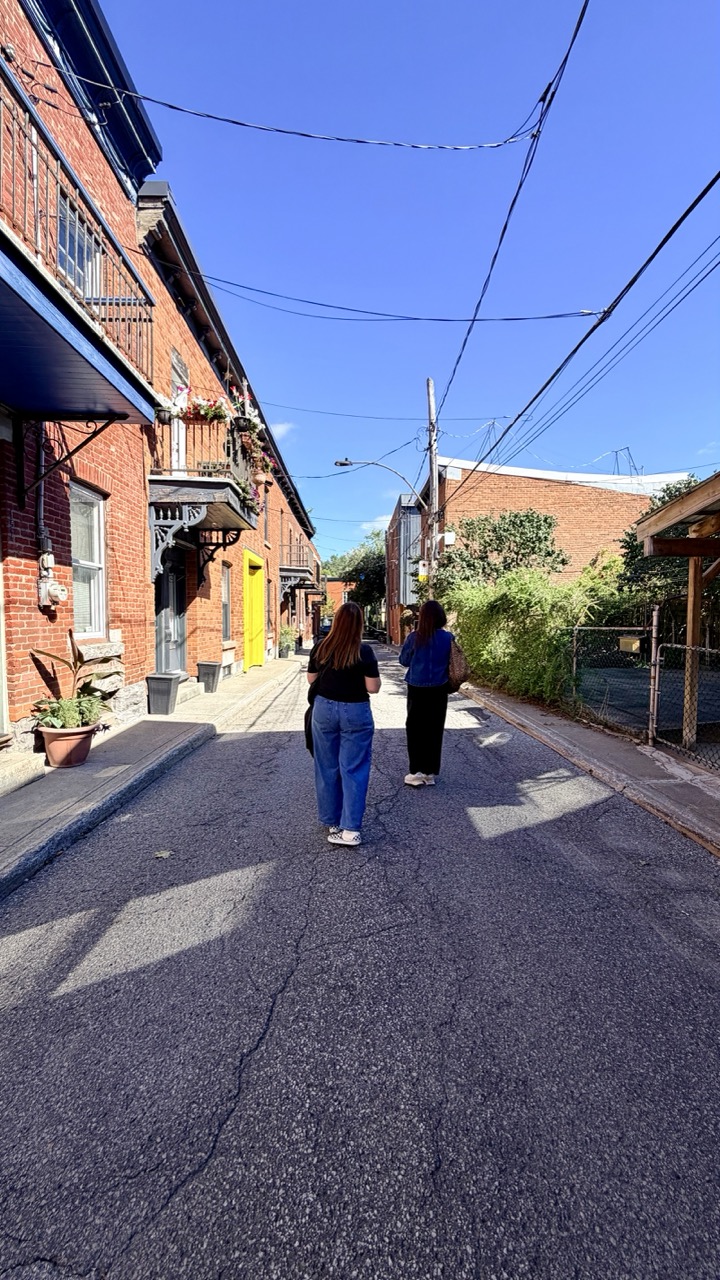
Red brick, asphalt, back doors, a few garages, and a web of electrical wires suspended above our heads. Montreal’s elegant facades have disappeared. Here, buildings show their reverse side: metal staircases, wooden balconies, basement windows, air-conditioning units, garbage bins, and doors that look as though they have been repainted ten times over the years.
But as we keep walking, our eyes adjust and the details begin to appear.
That is when the walk becomes interesting.
On the Other Side of the Houses
From the street, a house usually presents its best side. The front door faces the pavement, outdoor staircases curve across brick facades, and balconies overlook the city.
In the alley, nobody seems particularly concerned with appearances.
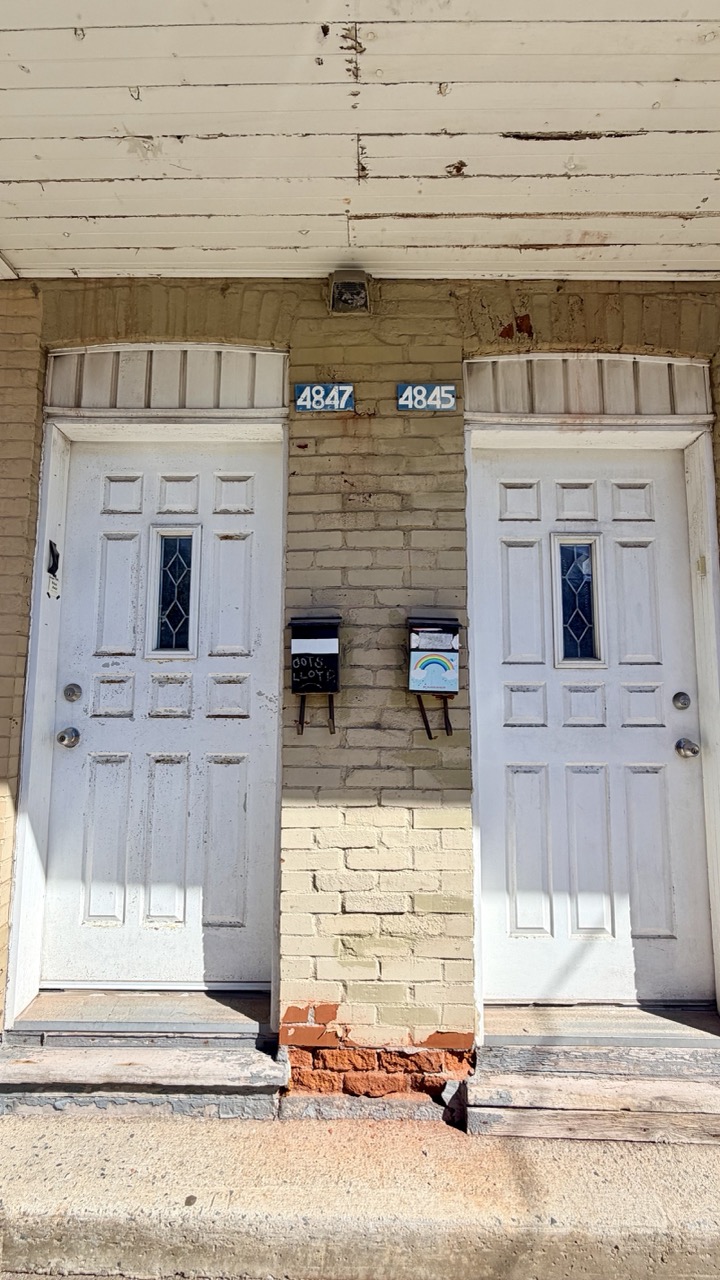
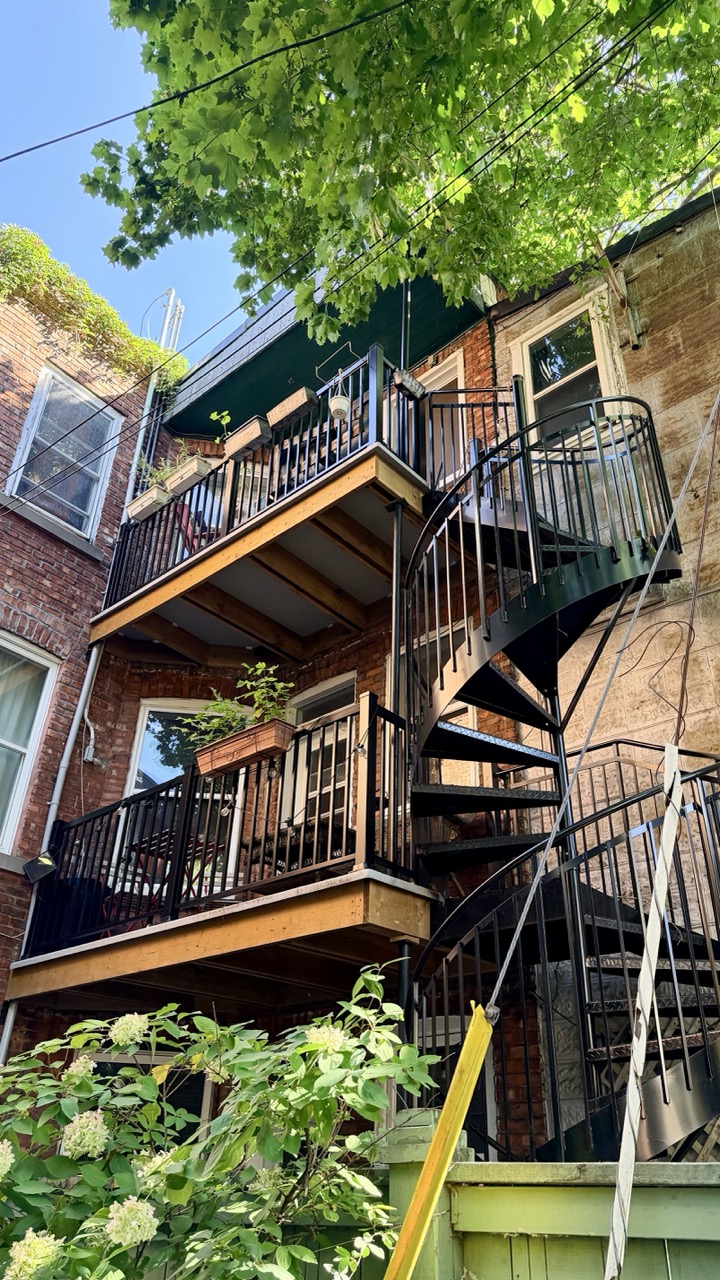
Two weathered white doors sit side by side beneath a balcony. Farther on, a wooden gallery hangs over the lane while a black spiral staircase winds down against a brick wall. Electrical cables crisscross the sky. A plant waits in a pot beside a doorway. A bicycle or a garbage bin might easily dominate the foreground.
And yet, that lack of perfection is precisely what I like.
We are no longer looking at Montreal as a city presenting itself to us. We are looking at how it actually works.
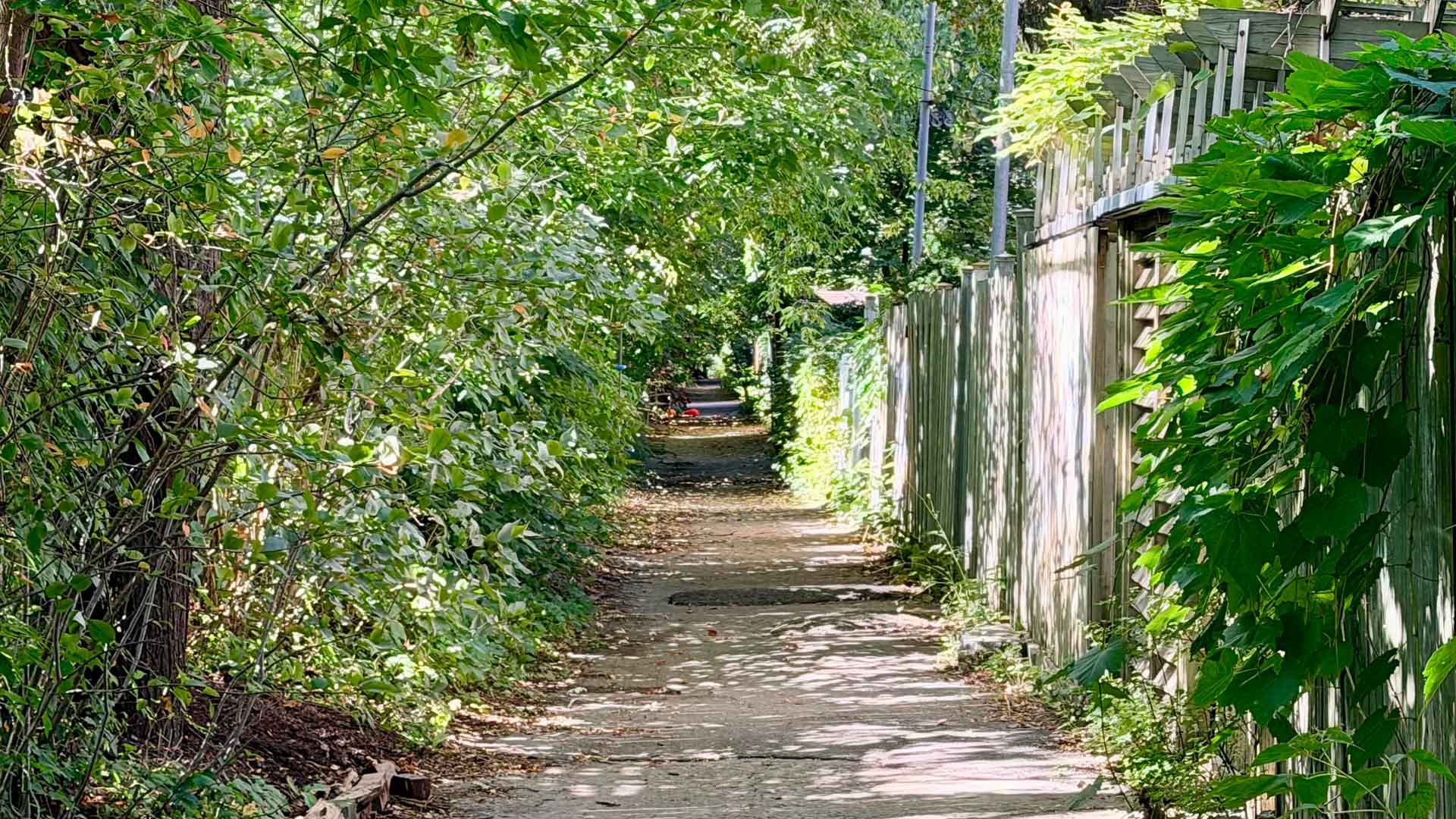
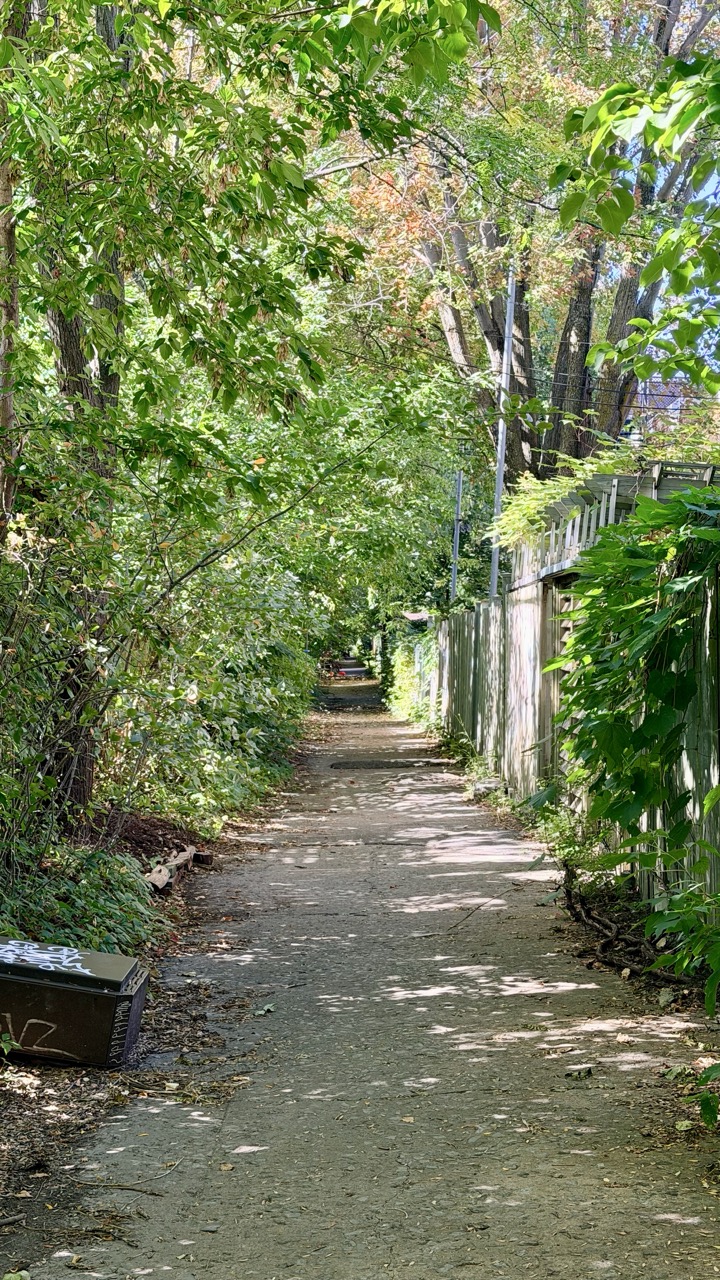
At the beginning of the walk, some alleys are almost entirely mineral. September sunlight falls directly onto the asphalt, bringing out the deep red of the brick beneath a nearly cloudless blue sky. A few streets later, the atmosphere changes completely. Trees begin to form a canopy above us, fences disappear behind leaves, and certain stretches become so green that, for a moment, it is easy to forget we are in the middle of Montreal.
That contrast stays with us throughout the walk.
The Tiny Things Nobody Travels to Montreal to See
The most amusing part begins when we notice what people have installed behind their homes.
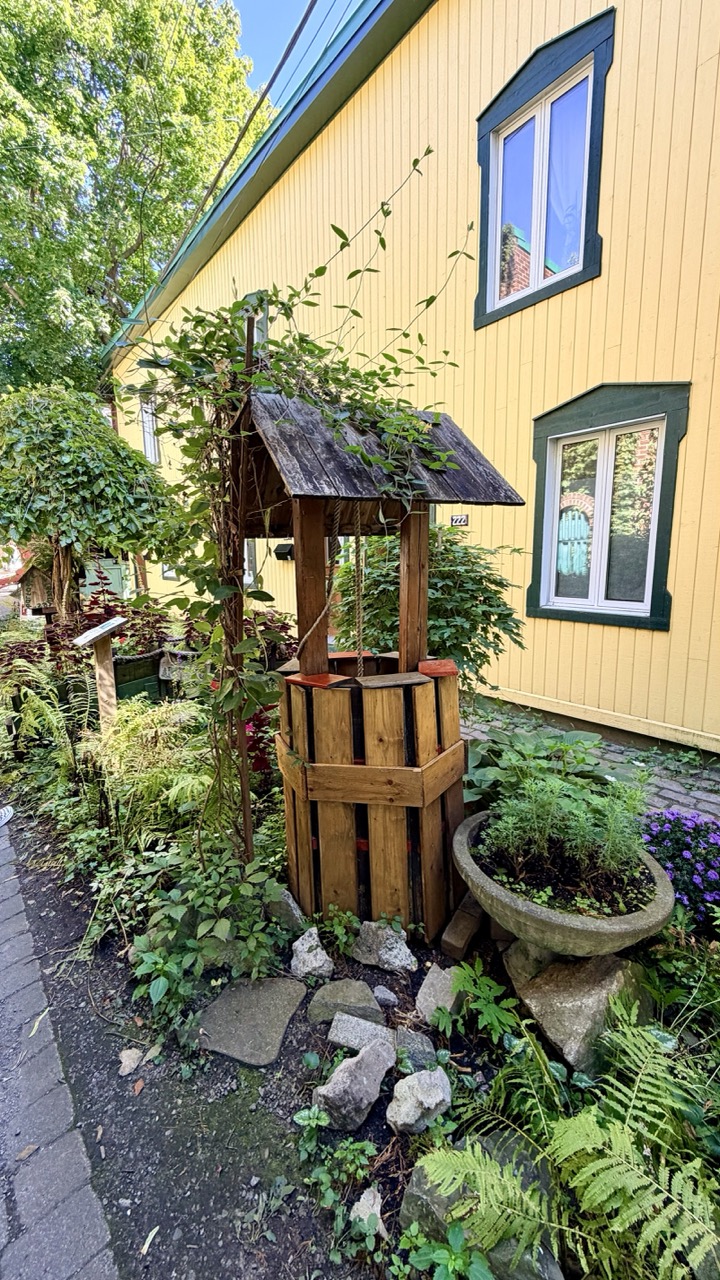
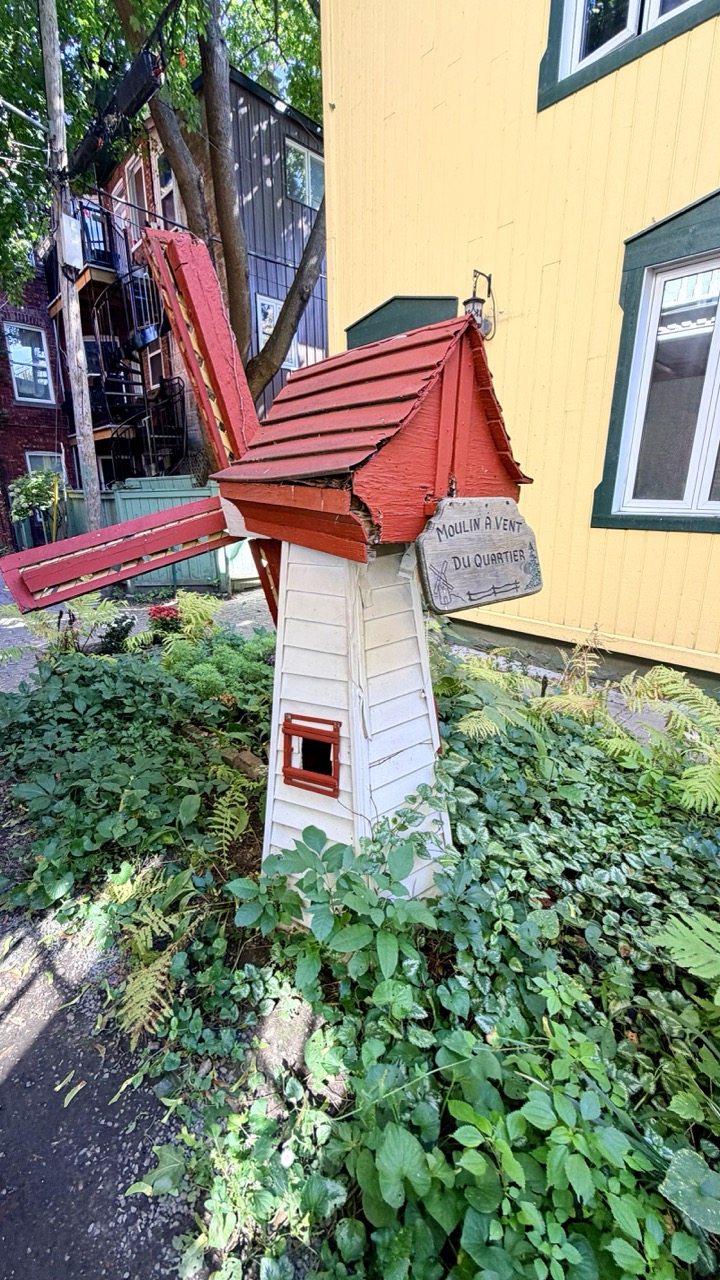
Beside a yellow house stands a tiny wooden well with a sloping roof, surrounded by ferns. A few steps farther on, we find a miniature windmill with red-and-white blades. A small sign even gives it a name: Moulin à vent du bonheur — the Windmill of Happiness.
I have no idea who decided one day that a Montreal alley needed its own windmill, but I love the idea.
It has no practical purpose. It does not appear in guidebooks. Nobody crosses the Atlantic to photograph it. It is simply there because someone felt like adding a little whimsy behind their house.
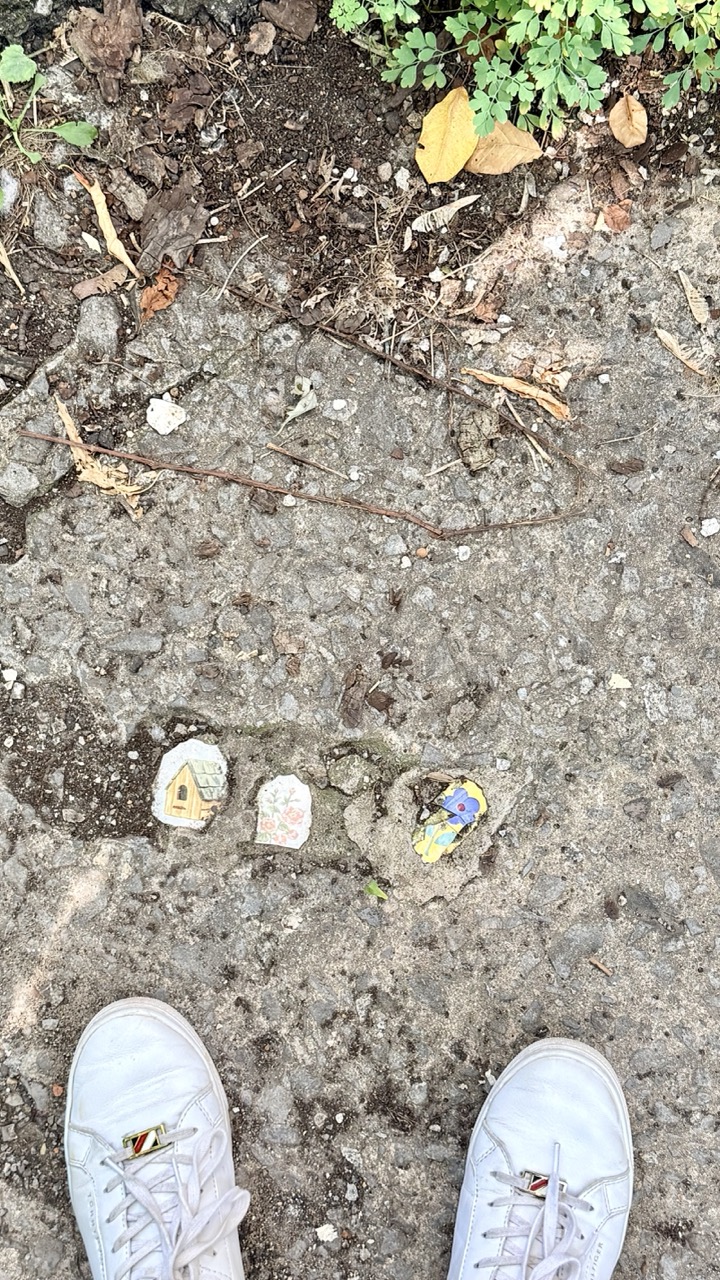
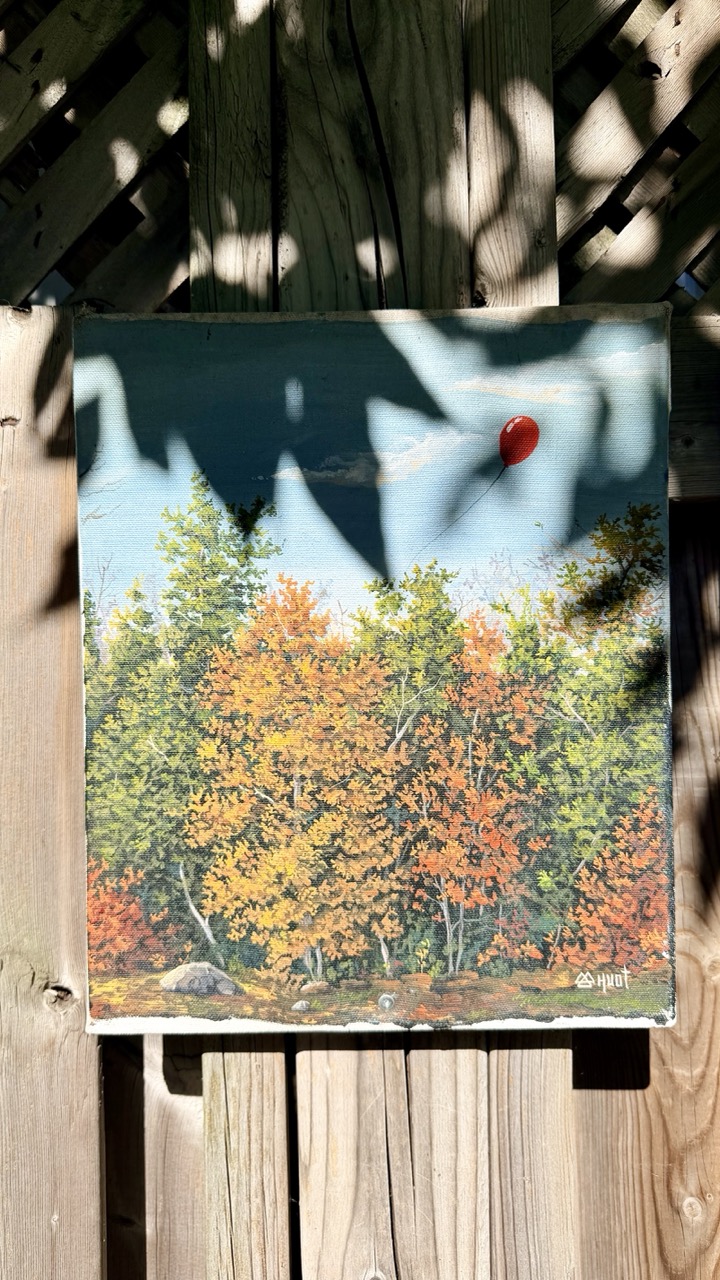
Later, we spot a turquoise birdhouse attached to a tree, then a small painting of an autumn forest fixed to a wooden fence. Elsewhere, tiny painted stones have been set into the ground. You almost have to watch your feet to notice them.
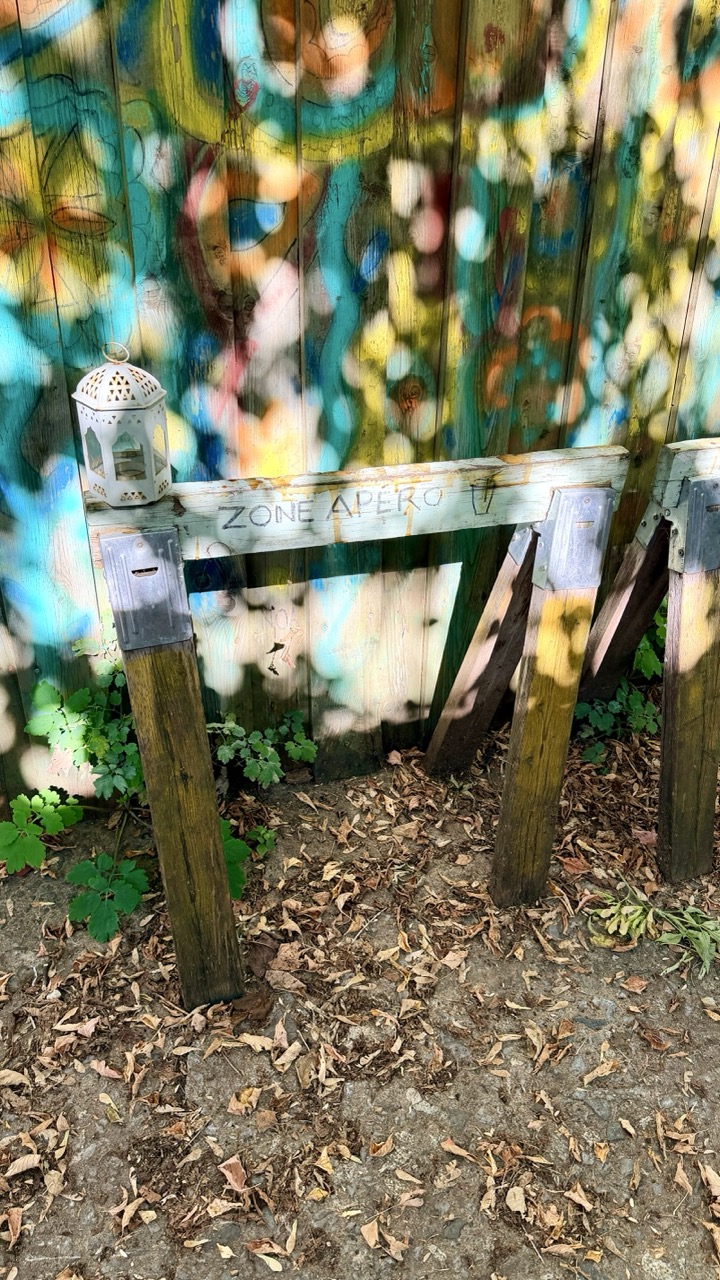
Farther along, a few planks of wood stretched between two posts form a very simple bench. Someone has written two words across the back:
ZONE APÉRO.
Now that is a piece of urban design I understand immediately.
None of these objects has anything to do with the others, except that they all tell the same story: the people living here do not simply use their alley.
They inhabit it.
And little by little, I realise that this may be exactly what Caroline is showing us.

When Montreal’s Alleys Were Simply the Back of the City
These passages filled with plants, games and handmade objects were not originally designed to become community gardens.
Montreal’s alleys began appearing in the nineteenth century. They provided access to the rear of properties, stables, sheds and secondary dwellings. As the city became denser, they became part of its everyday workings: goods, coal, horses and, later, cars all moved behind the houses.
That is what makes walking through them today so interesting.
The space once reserved for everything people preferred not to place in front of the house has, in some neighbourhoods, become the most charming part of the block.
The staircases and balconies are still there. So are the garages. A clothesline stretches across one courtyard, reminding us that we are quite literally walking behind people’s homes. Yet between all of this, trees, flowers, vegetable gardens and a multitude of small handmade details have taken root.
Some alleys have become genuine shared spaces.
In Montreal, that transformation accelerated with the development of green alleys, projects largely initiated by local residents. The city now describes them as places that encourage greenery, neighbourly interaction and children’s play.
On paper, the concept sounds almost administrative.
In an alley, all it takes is one tree and a rope hanging from a branch to understand what that really means.
Pirate Alley: Where Children Seem to Have Taken Over
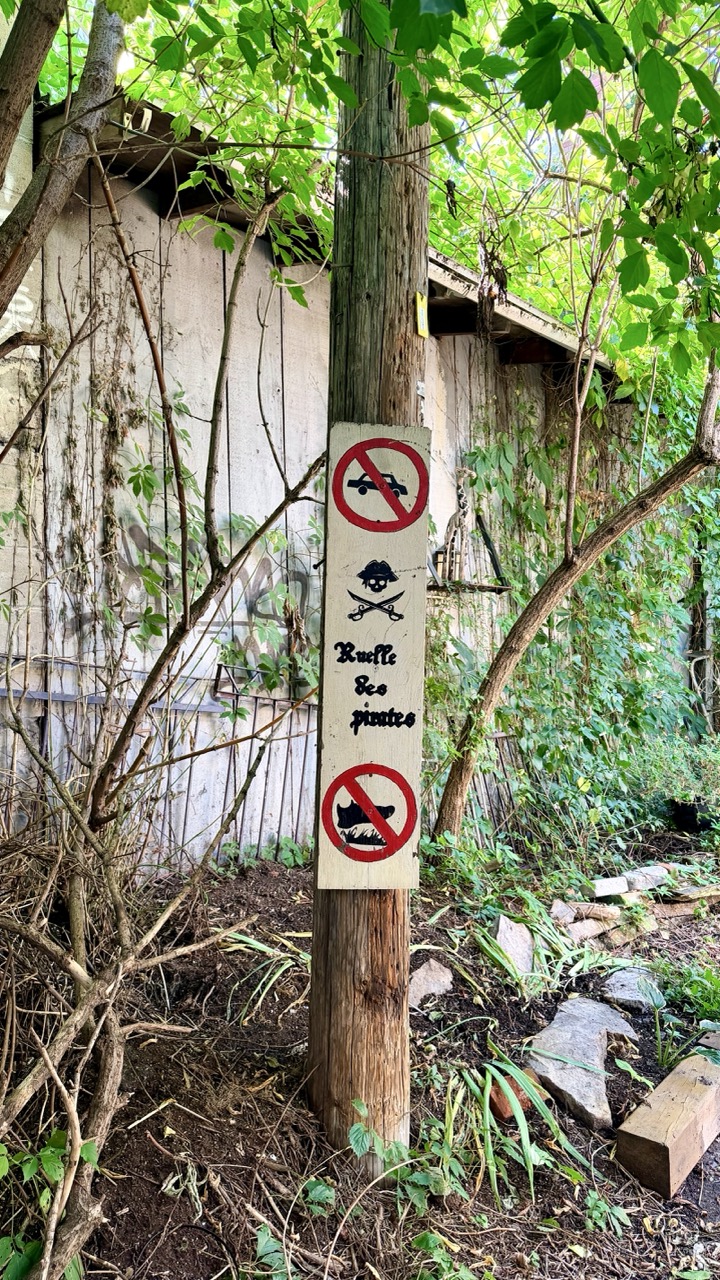
Pirate Alley is probably where that feeling becomes most obvious.
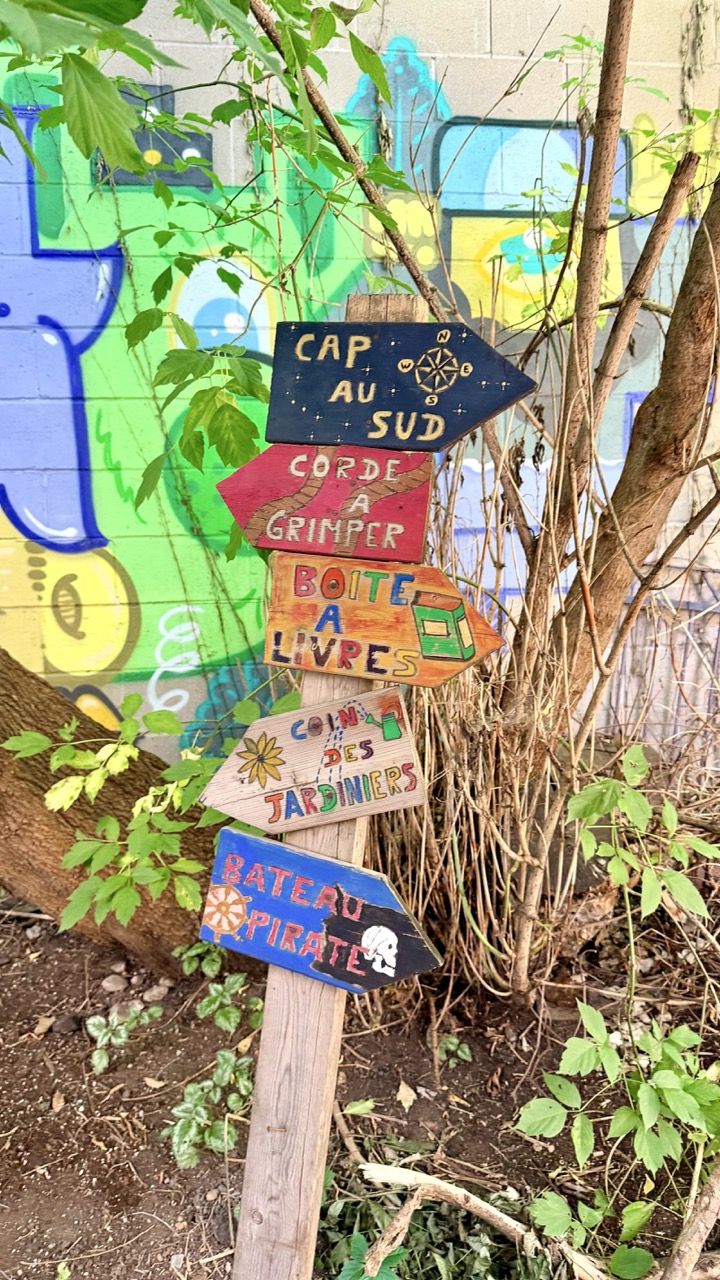
Beneath the trees, handmade signs point towards places that seem to belong to a world with its own rules.
One arrow reads Cap au Sud. Another points towards a corde à grimper, a climbing rope. Lower down, there are signs for a boîte à livres, a book box, and the coin des jardiniers, the gardeners’ corner. Each has been painted by hand in different colours on rough pieces of wood cut into arrows.
It does not take much imagination to understand why the alley has its name.
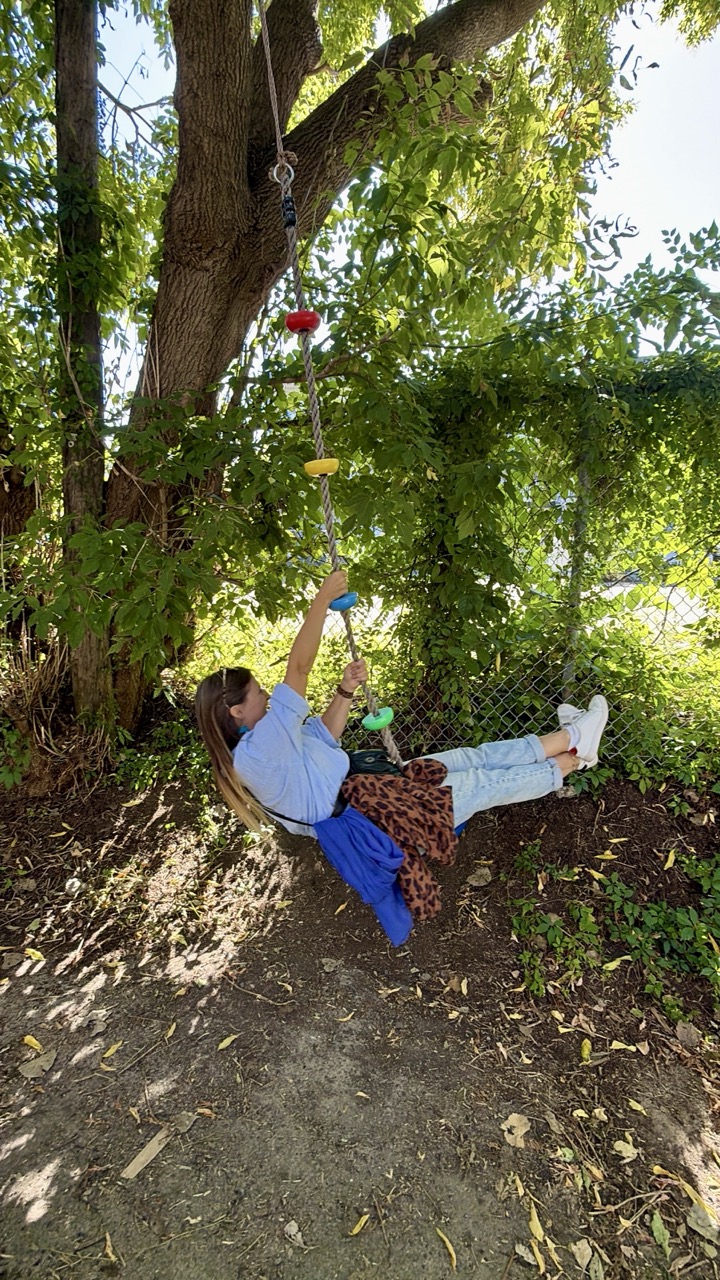
A little farther on, the rope itself hangs from an enormous branch, dotted with colourful climbing holds for children to grab onto, climb, or simply swing beneath the leaves.
All around us, the vegetation is thick. The ground is uneven, trees seem to have slowly reclaimed territory from the fences, and a handmade sign nearby reminds visitors of the rules.
This no longer feels like a simple access lane.
It feels like a playground that has forgotten it sits in the middle of a major city.
And suddenly, the history of Montreal’s alleys becomes very tangible. For generations, they served as neighbourhood playgrounds. No perfectly designed play structure was necessary. A tree, a rope, a few scraps of wood and a lot of imagination were enough.
What I like most is that none of this seems designed for visitors.
We are simply passing through a place that residents created for themselves.
The Cachalot Hidden Behind Laurier
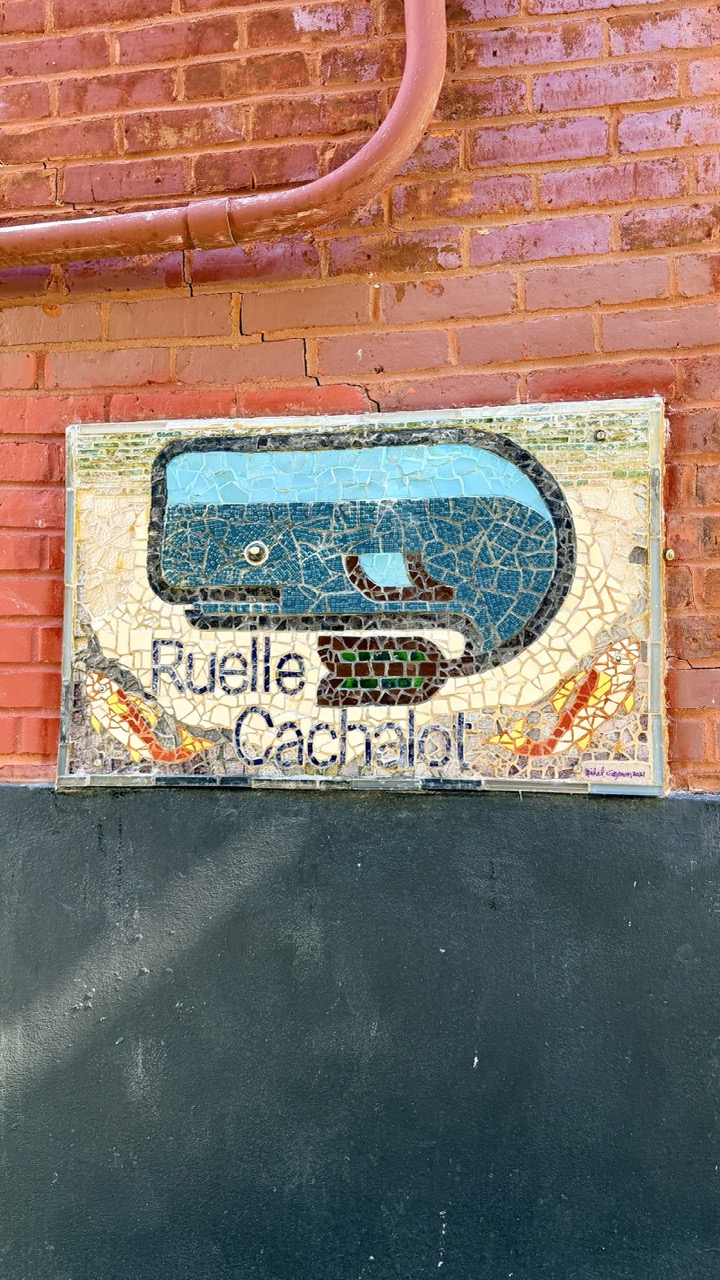
A few alleys later, we come across a mosaic fixed to a wall.
A large blue sperm whale swims among small colourful fish. Beneath it, two words:
Ruelle Cachalot.
There is no mistaking the entrance.
The name might suggest some unlikely maritime story, but its origin is much more local. It is simply made up from the names of the surrounding streets: CA from Cartier, CHA from Chabot and LOT from Laurier.
CA-CHA-LOT.
Cachalot.
I love details like this because they say so much about what is happening in these alleys. Residents could have left the passage anonymous. Instead, they gave it a name, and with that name, a personality.
Behind that identity lies a community. Local accounts mention shared workdays, neighbours lending one another tools, a small lending library, and even gatherings organised in the alley. One resident once set up a giant screen outside so the neighbourhood could watch a World Cup match together.
The alley is no longer the empty strip dividing two rows of houses.
It becomes the space connecting them.
A Garden Made of Hundreds of Small Decisions
The farther we walk, the more I notice the plants.
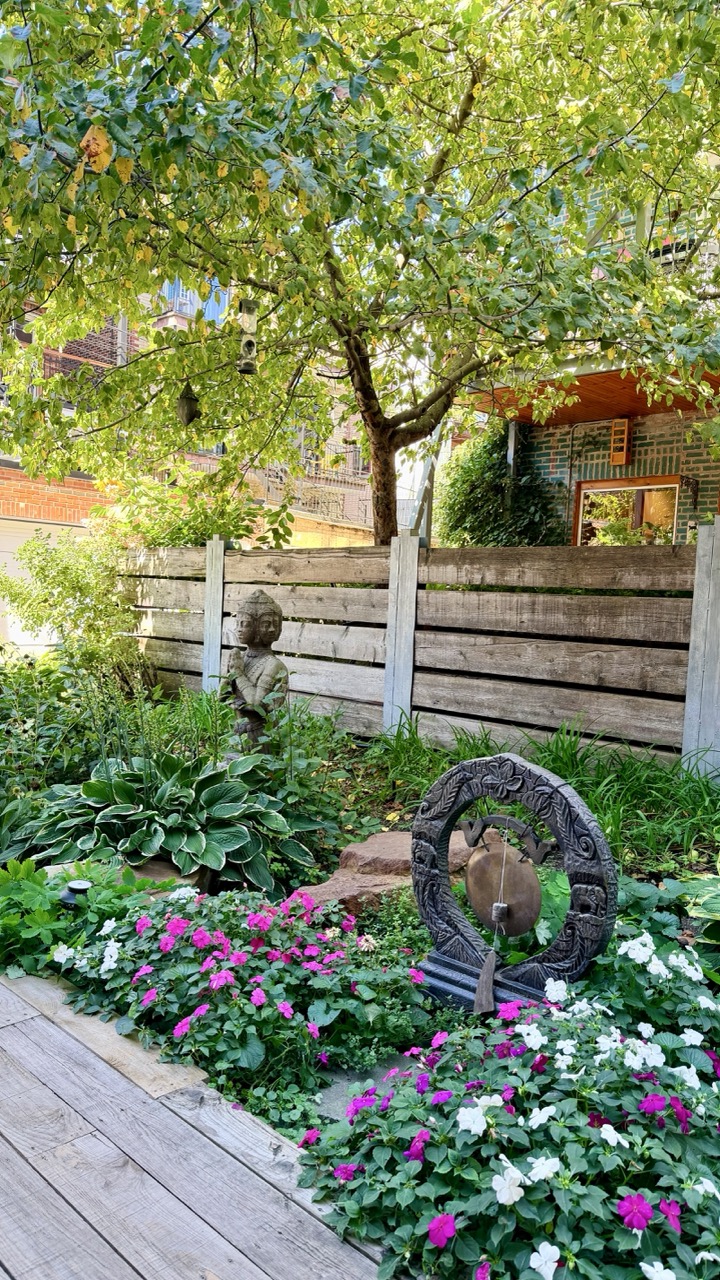
Not only the impressive trees spreading their branches above the fences, but everything growing beneath them too: hostas, ferns, clusters of pink and white flowers, ivy climbing walls, and plants spilling from private gardens into the alley.
In places, it almost feels as though we are walking through a green tunnel.
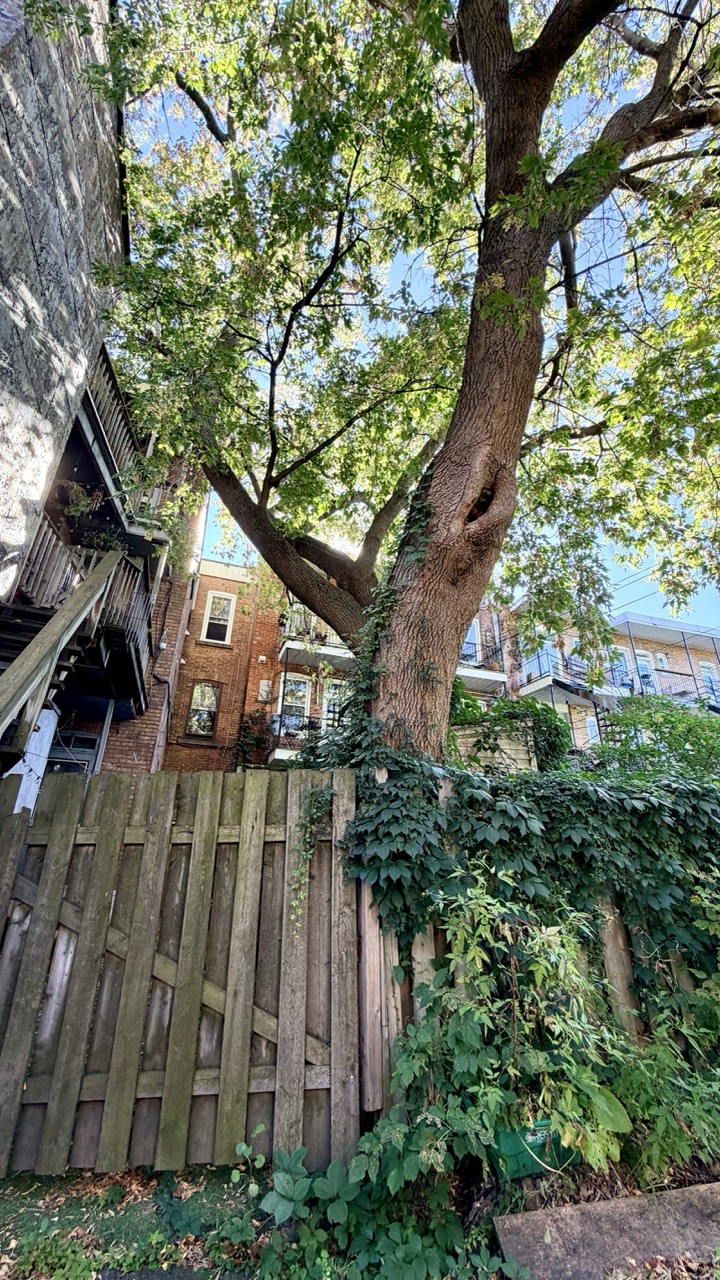
An enormous tree rises behind an old wooden fence and seems to have decided long ago that it is the true owner of the property. Its trunk is so wide that the houses around it suddenly look small. Climbing plants cover the fence boards, while its branches reach across the alley.
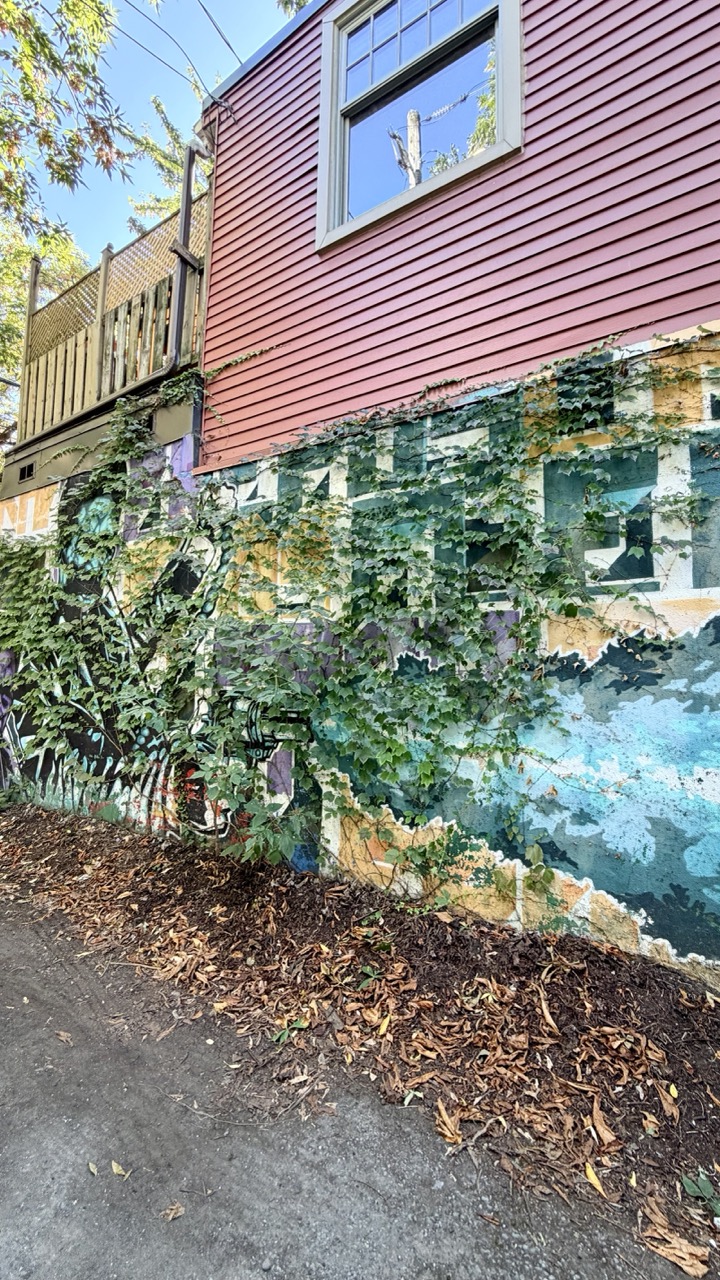
Elsewhere, the boundary between vegetation and city infrastructure is much messier. A painted wall slowly disappears under foliage. An old fence becomes a trellis. A birdhouse is wedged among branches.
These are gardens, but not in the traditional sense.
Nobody seems to have designed them for you to stand in front of and say: there is the garden.
They spill over.
And that may be exactly what makes them so pleasant.
Modigliani Alley, Where Garage Doors Become Canvases
Then we reach Modigliani Alley.
Here, the walls begin to take part in the scenery too.
The alley runs between De Brébeuf and Chambord, north of Gilford. Its transformation began in the late 1990s, when residents started thinking about how to green and reshape what had been a heavily paved space. The many garage doors presented an obvious obstacle, but instead of treating them only as a problem, some were gradually turned into artistic surfaces.
Over time, the alley became a kind of open-air gallery.
What I like about the artworks we see is that they are not separated from everyday life.
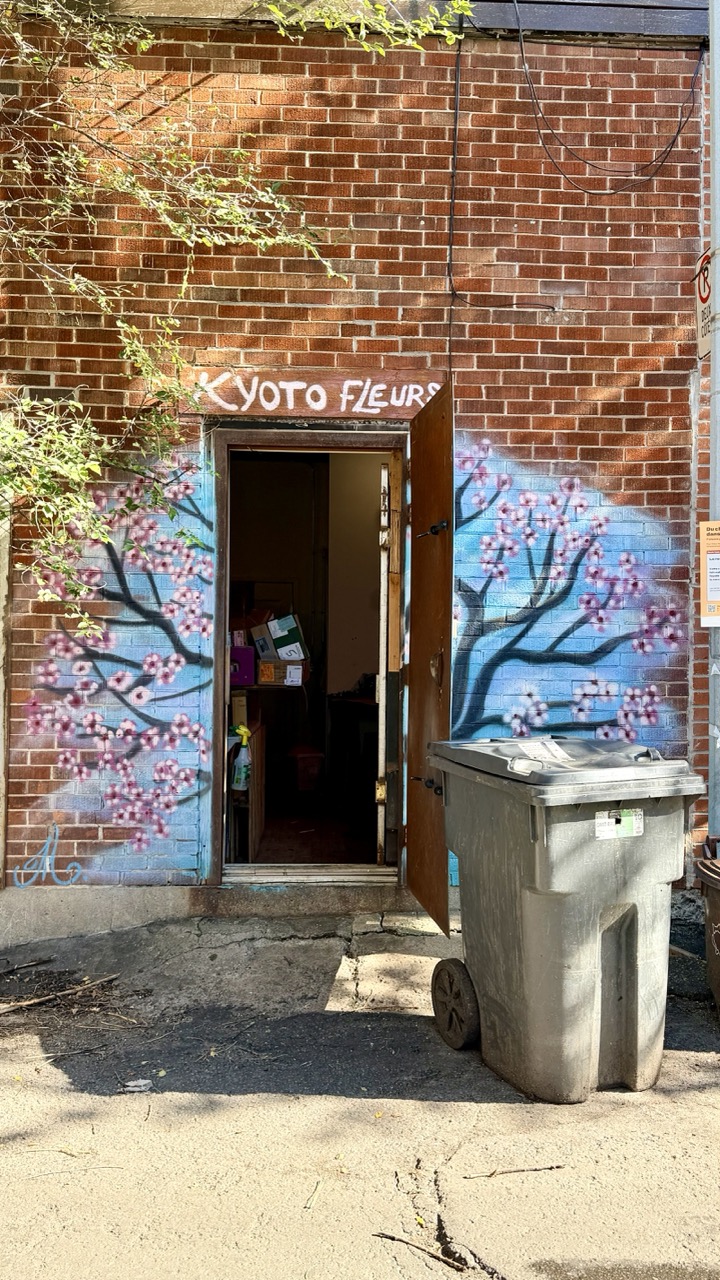
A large mural appears against a brick wall with a garbage bin sitting directly in front of it. Branches cut across part of the painting. Elsewhere, painted pink blossoms frame an open garage door, through which you can see boxes and household items stacked inside.
The art has not replaced the function of the alley.
It has simply moved into it.
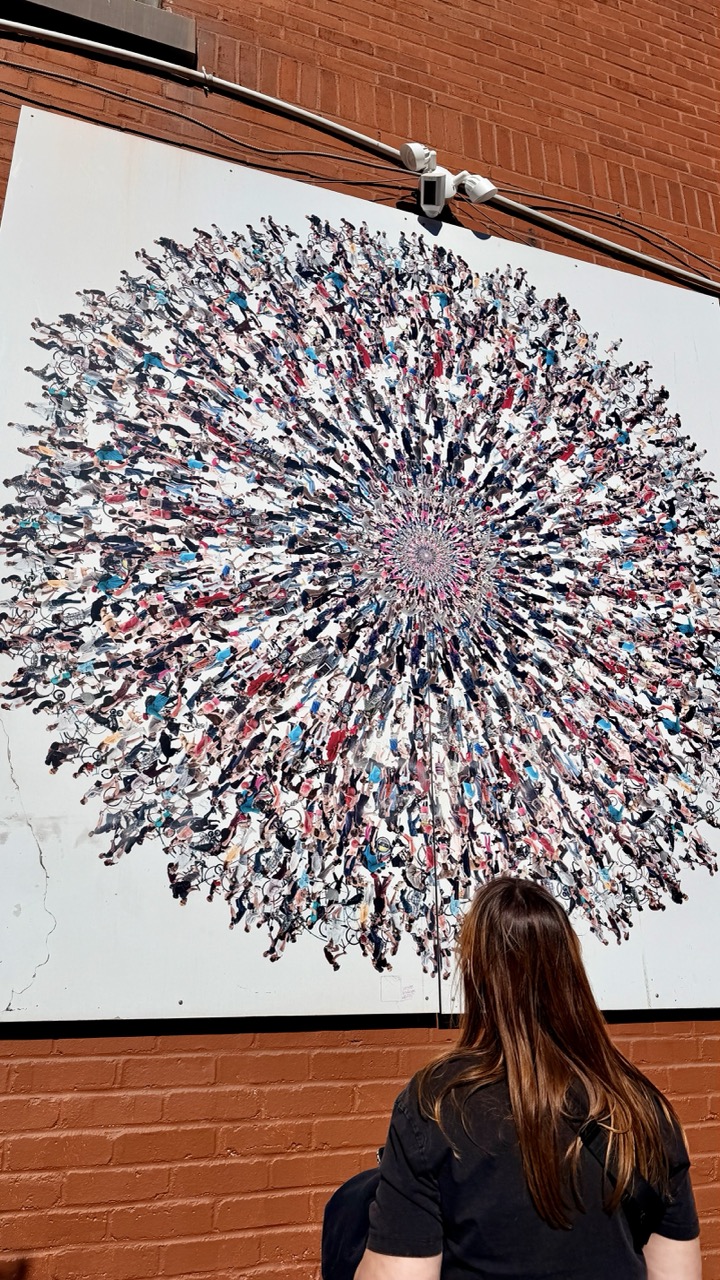
Farther along, a huge artwork inevitably catches our attention. Hundreds of tiny figures appear to radiate from a central point, forming a vast circle in motion. You have to step back to take it all in.
And that is what I remember most about Modigliani: an outdoor art gallery where nobody removed the garbage bins, balconies, fences or electrical wires before we arrived.
Thankfully.
Otherwise, it would no longer feel like an alley.
Laundry Drying in the Sun
Towards the end of the walk, a much more ordinary scene reminds me once again why I enjoy discovering a city this way.
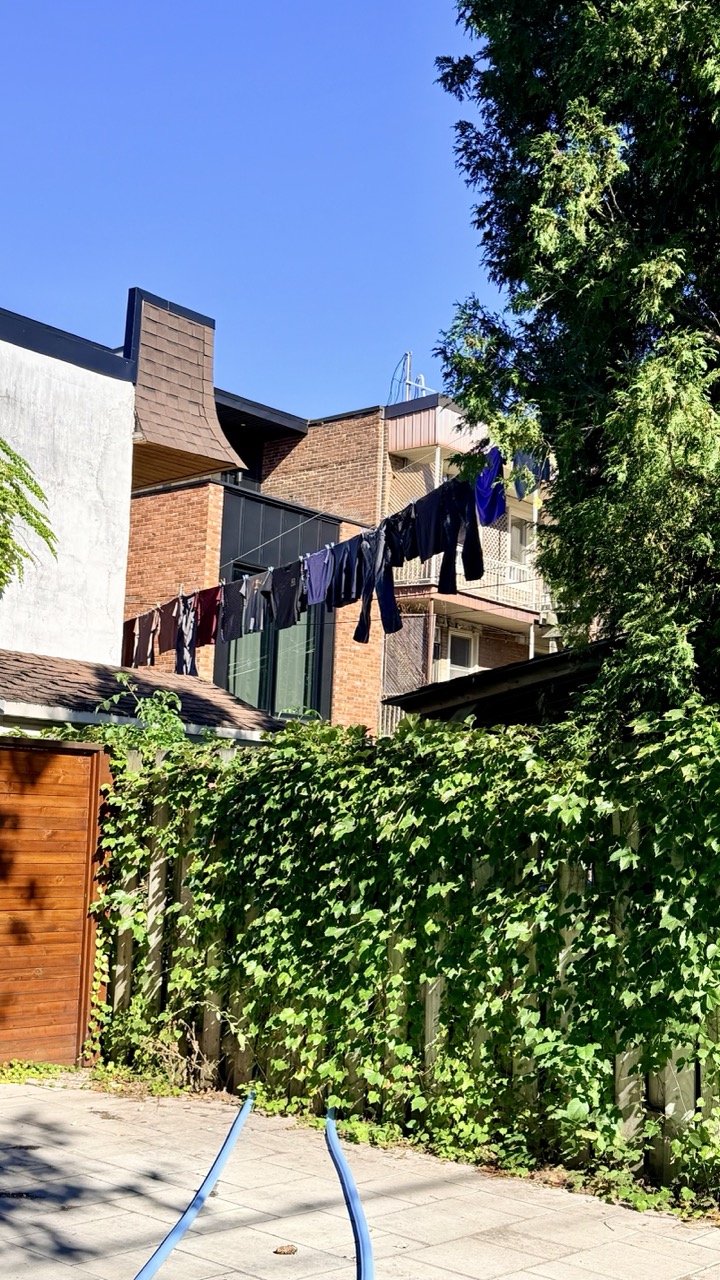
A clothesline stretches across a courtyard above the alley.
Trousers, T-shirts and dark clothing dry in the sun above a thick green hedge. Behind them, apartment balconies and brick walls rise into view.
Objectively, there is nothing here to visit.
And yet, the scene says something about Montreal more clearly than some monuments do.
It speaks of apartments fitted tightly together, neighbours living close to one another, tiny courtyards, summers spent outdoors, and the way private and public space almost touch in the alleys.
We are in a major city, yet some of these passages still function like tiny villages.
You can sit on a bench a few metres from your back door, call to a child playing farther down, talk to a neighbour over a fence or leave books in a box for someone else to take.
Nothing spectacular.
Simply another way of living together.
What an Alley Reveals That the Street Does Not
After following Caroline from one alley to another, stepping briefly back onto the street before disappearing behind the next row of houses, I finally understand why I am enjoying the walk so much.
When I travel, I spend a great deal of time looking for exactly this sort of thing.
I leave the main streets. I wander through markets. I watch people outside their homes. I try to understand how a neighbourhood works when nobody is particularly trying to show me anything.
And that day, we are doing exactly the same thing in Montreal.
The only difference is that I am at home.
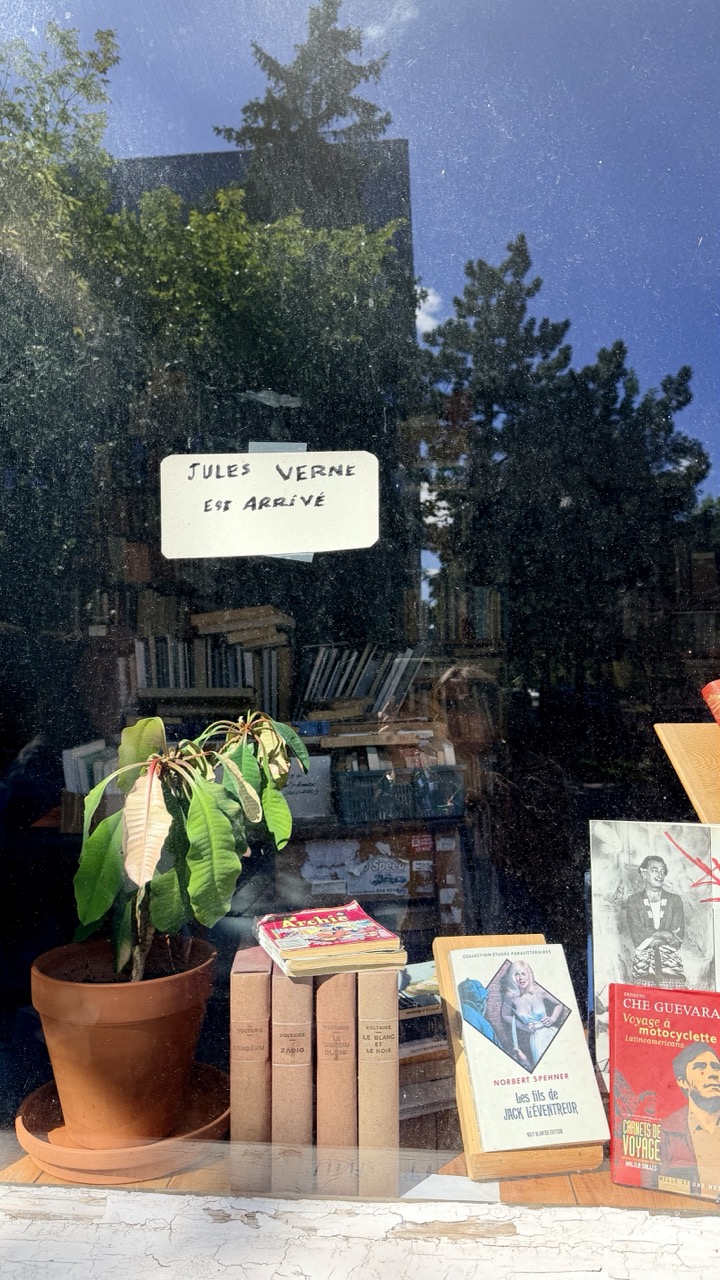
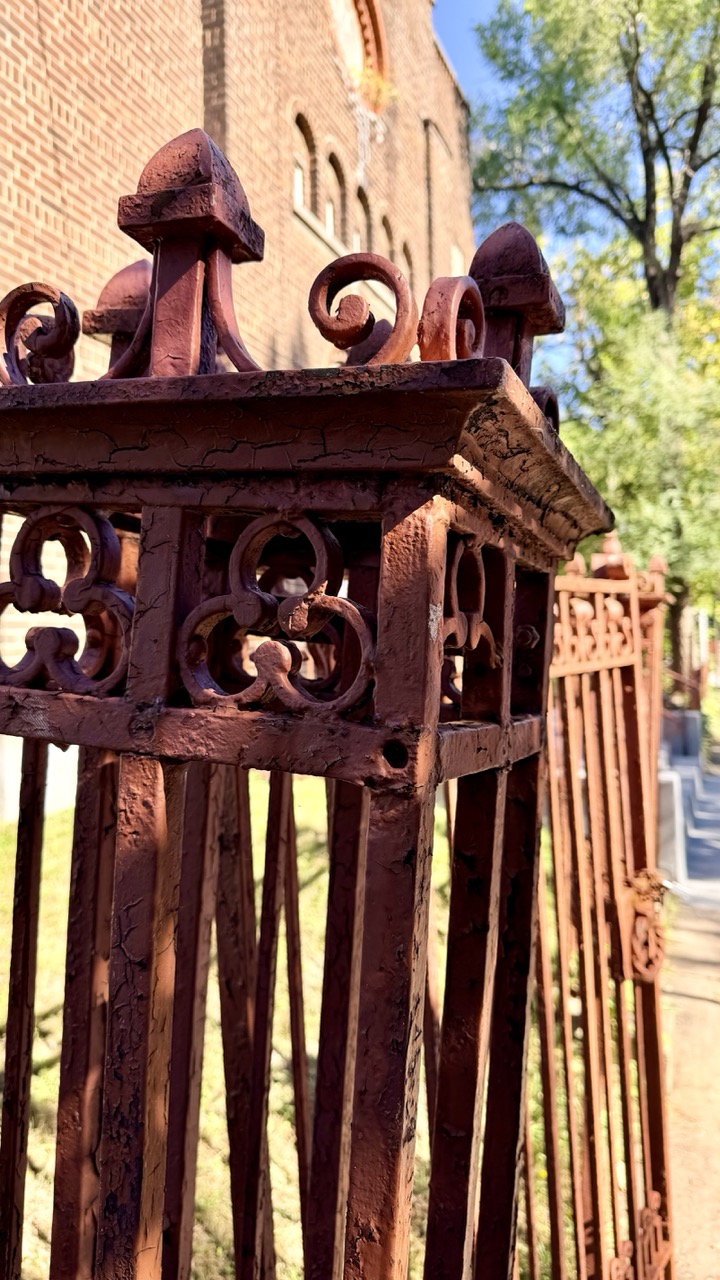
A shop window we pass announces, rather mysteriously, that “Jules Verne has arrived.” An old rusted iron gate turns almost golden in the afternoon light. In another alley, leaf shadows flicker across walls and fences. A few metres away, graffiti slowly disappears beneath ivy.
None of these details would have given me a reason to travel across the city.
Together, however, they give the walk its personality.
That is often how the journeys I remember best work too.
They rarely stay in my memory as a sequence of extraordinary sights. What remains is usually a detail: a meal, a conversation, an old sign, a child playing, an open doorway, a smell, a particular kind of light.
Here, perhaps it will be that small red-and-white windmill hidden behind a yellow house.
Or the sign saying Zone Apéro.
Or the rope hanging from a tree in Pirate Alley.
A City Within the City
Eventually, we return to broader streets and, little by little, Montreal puts its facade back on.
Cars pass. Shops appear. Houses become the ones we normally see from their front entrances.
But behind them, I now know there is another network entirely.
Tiny gardens, handmade benches, murals, birdhouses, climbing ropes, libraries, laundry drying in the sun, and trees that have grown far too large for the fences around them.
In the end, Caroline has not shown us a “secret Montreal” in the sense that nobody knows these places exist.
She has shown us something much simpler: the Montreal we do not see when we stay on the main streets.
And perhaps that is why I enjoyed this walk so much.
There was no need to board a plane, rent a car or go very far.
All we had to do was step behind the houses.
Since then, every time I pass the entrance to an alley, I find it a little harder to keep walking straight ahead.