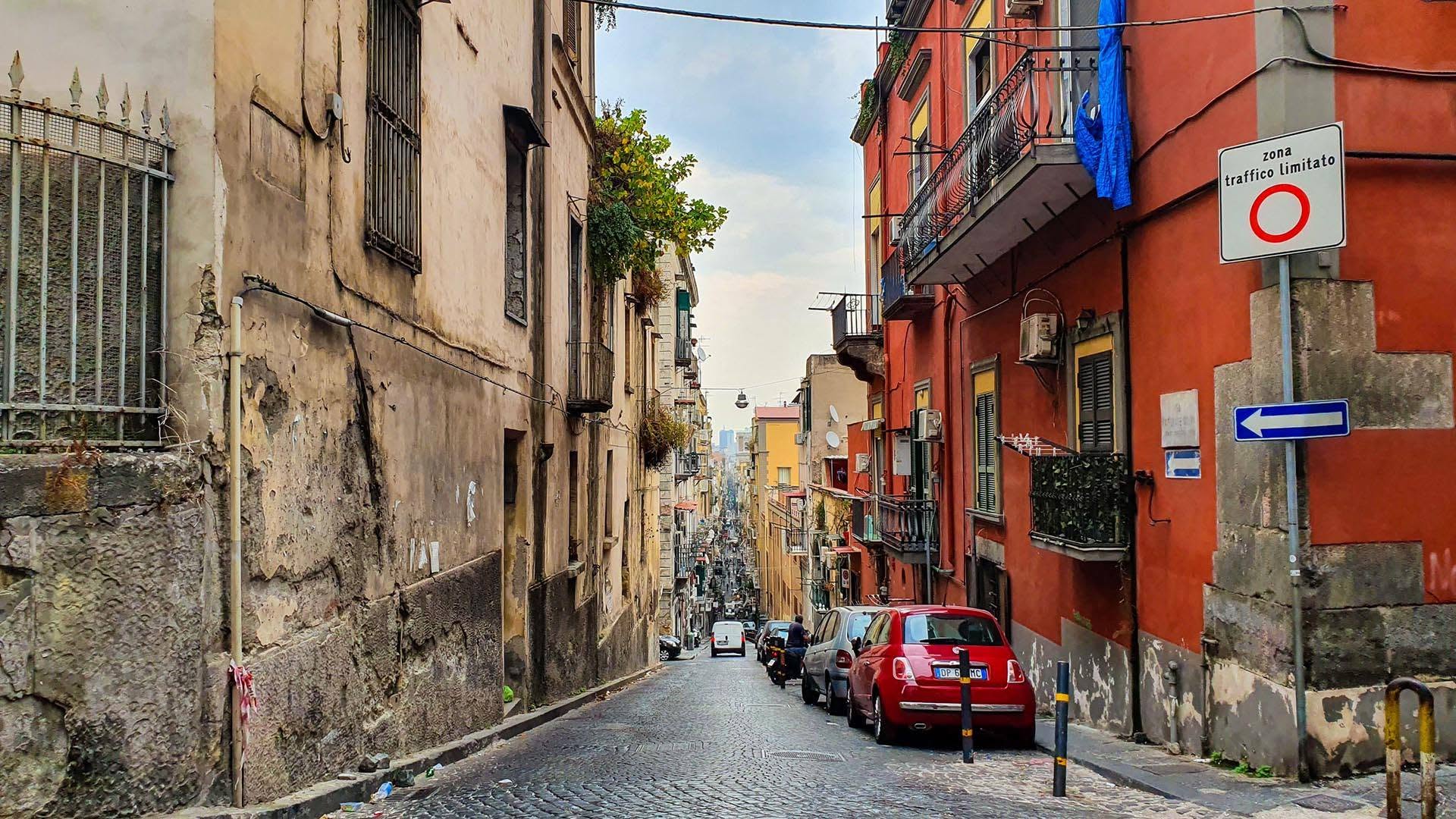
Some cities let you approach them slowly, as though they first want to make sure you deserve their trust. Naples does not bother with that. It grabs you within the first few minutes, without preamble, without excessive politeness, with its noise, its scooters, its peeling façades, its voices bouncing off the walls, its smells of strong coffee, hot fried dough, damp laundry and the sea just nearby.
In Naples’ historic centre, nothing ever seems quite in its proper place. Churches appear suddenly among tired apartment buildings, palaces sometimes look abandoned, scooters skim past pedestrians with an almost artistic confidence, and conversations continue from one balcony to another as though the entire city lived inside the same house. It is chaotic, yes. Sometimes a little harsh. Often disorienting. But behind all that agitation, there is a depth you only begin to understand by walking.
Naples is not a city you visit only with a list of addresses. You move through it with open eyes, attentive ears and a certain tolerance for disorder. Here, beauty does not always arrive neatly lit, with an explanatory sign and a well-organised queue. It appears around the corner of a street, in a Baroque façade wedged between two blackened buildings, in a gilded altar behind a half-open door, in the gesture of a man hanging laundry above a narrow lane, or in the gaze of an elderly woman watching over neighbourhood life from her balcony.
Before walking through Naples, you have to accept one thing: the city of today and the city of yesterday are not separate. They overlap. Greek, Roman, Angevin, Aragonese, Spanish, Bourbon and working-class Naples still exist in the same streets as the horns, markets, graffiti and queues outside pizzerias. The historic centre is not a frozen museum. It is a living memory, noisy, sometimes battered, but incredibly generous.
Naples, the city that never stopped mattering
It all begins long before the palaces and grand squares. Around 470 BC, Greek settlers founded Neapolis here, the “new city”. The name has remained, barely altered by the centuries. Naples was one of the great cities of Magna Graecia, that “Greater Greece” which shaped part of southern Italy before Rome became the immense power we know.
This Greek past is not a piece of information you file away in the back of your mind before moving on. In Naples, it still rises to the surface. You find it in the layout of certain streets, in the density of the centre, in those layers of history that seem to grow one over another. Later, the city became Roman, then Byzantine, Norman, Swabian, Angevin, Aragonese, Spanish and Bourbon. Each power left something behind: a church, a fortress, a square, a palace, a habit, a wound, a pride.
Between the 13th and 15th centuries, under the Angevins, Naples expanded. Great churches rose, neighbourhoods spread, and the city asserted its importance. The Aragonese marked Naples with solid castles and more ambitious palaces. Then came the Bourbons, from 1734 onward, launching major architectural projects and giving Naples the air of a European capital. You can still feel that ambition when crossing certain squares, even when the façades have lost their original glow.
Perhaps this is what makes Naples so fascinating: its grandeur has not disappeared, but it does not always try to show itself at its best. It is there, mixed into daily life, into the scooters, the vendors, the crumbling walls, the running children, the slightly lost tourists, the Neapolitans who seem to know exactly how to navigate this magnificent disorder.
Beginning with space: Piazza del Plebiscito
I begin the day on Piazza del Plebiscito, a vast breath of air at the edge of the city. After the tight lanes, crowded pavements and close-set façades, the square almost feels dizzying. Suddenly, Naples opens up. The sky takes up more room, footsteps echo differently, and the air seems to move more freely.
Piazza del Plebiscito has something theatrical about it. It was imagined in the early 19th century, at a time when the idea was to honour Napoleon, before political changes altered the plans. Its name comes from the 1860 plebiscite, when Naples joined the Kingdom of Italy. But in the moment, it is not the dates that strike first. It is the scale. That feeling of being tiny in the middle of an urban stage set designed to impress.
On one side, the Basilica of San Francesco di Paola stretches its columns like a Neoclassical backdrop. It could have been dedicated to Napoleon, but it ultimately became a church, completed in 1816. Its name recalls Saint Francis of Paola, who is said to have stayed in a monastery on this site in the 16th century. When the doors are open, the interior is worth stepping into for a few minutes. There is, in these large Italian churches, a particular kind of coolness, a smell of stone, wax and silence, as though the noisy city had suddenly been left outside.
Opposite, the Royal Palace imposes another kind of presence. Built in the 17th century, it became one of the Bourbon residences in the 18th century. You can pass through the main gates, cross the courtyard, glimpse the gardens, look through the glass at the entrance and its grand staircase. Even without visiting every room, you sense something of royal Naples, of this city that was long far more than just a stop in southern Italy.
Around me, people cross the square without always looking up. Families walk slowly, children chase pigeons, couples take photos, vendors wait patiently under the sun. Naples has this very Italian way of making monumental settings feel almost domestic. What might seem solemn elsewhere becomes here a place of passage, meetings, conversations and life.
Stones of power: Castel Nuovo
Leaving the square, I make my way to Castel Nuovo, that medieval mass that seems to guard the city with a slightly tired seriousness. Built from 1279 onward, it was not only a fortress. It was also a palace, a residence, a symbol of power. For centuries, it was associated with the rulers who governed Naples, until the early 19th century.
From the outside, the castle impresses immediately. Its thick towers, dark walls, and pale marble triumphal arch set into more austere stone all recall that Naples was a strategic city, contested and coveted. You can visit the interior, even if some parts sometimes give the impression of having known more radiant days. But it is precisely this contrast that says something about Naples. Here, monuments are not always perfectly polished for the visitor. They keep their uses, their transformations, their fatigue.
I stay for a while looking at the walls. The stones carry that density you often find in Italy, that sensation that centuries are not behind us, but all around us. In Naples, history is never very far away. It does not confine itself to being told in museums. Sometimes it blocks traffic, occupies a square, houses offices, or simply rises in the middle of an ordinary day.
Beneath the glass of Galleria Umberto I
A few steps away, the atmosphere changes. Galleria Umberto I appears like a more elegant interlude, almost Parisian in its ambition, Neapolitan in its state of soul. Completed in 1891, it was part of a vast project intended to modernise and beautify Naples at the end of the 19th century. You enter beneath a grand structure of glass and metal, with that impressive central dome letting light fall onto the interior façades.
Your eyes naturally lift toward the cupola, its metal ribs, its curves, that impression of controlled space. Then they come back down to the floor, where the details deserve just as much attention. The mosaics, the patterns, the intersecting passages: everything recalls an era when shopping arcades were also statements of modernity.
There were periods of neglect, and you can still feel that in places. Some parts shine more than others, some details seem to be waiting their turn to be restored. But once again, Naples does not completely hide its scars. Galleria Umberto I remains beautiful precisely because it is not only beautiful. It has lived. It has lost a little of its brilliance, then partly found it again, like those elegant women who do not need to be perfectly coiffed to draw every gaze.
Around me, footsteps echo on the floor, voices rise toward the glass, passers-by lift their heads for a few seconds before continuing on their way. I think to myself that Naples is often like this: a city you understand better when you take the time to look at both the ceiling and the cracks.
Climbing above the disorder: Castel Sant’Elmo
From the Augusteo stop, the funicular climbs toward the heights. Simply leaving street level already changes the way you perceive Naples. Down below, everything is movement, proximity, noise. As you climb, the city begins to spread out, to take shape. Roofs replace horns, lanes become lines, and the bay gradually appears as something obvious.
Castel Sant’Elmo dominates Naples with an almost military solidity. Its first major fortified structure dates from the first half of the 14th century, and unlike other castles in the city, this one long retained an essentially defensive function. It was used for military purposes until the 1970s.
You can visit the castle and its art gallery, but the main reason to come up here can be summed up in one word: the view. From the heights, Naples reveals itself differently. The city seems immense, dense, compact, as though every house, every dome, every terrace had been pressed against the others so as not to waste a crumb of space. The bay opens in the distance, Vesuvius watches over it in a soft haze or a clearer light depending on the hour, and the sea gives all this agitation an almost soothing boundary.
From up there, Neapolitan chaos suddenly becomes more legible. You better understand the geography, the relationship between the city and the sea, between the hills and the old neighbourhoods. And yet, even at a distance, Naples never becomes truly tame. It keeps something vibrant, nervous, profoundly alive.
I stay for a while looking at the rooftops. The hanging sheets, the antennas, the domes, the tiny terraces, the façades pressed tightly against one another. Seen from above, the historic centre looks like a dense, almost organic substance. An urban body that breathes, grumbles, sings, cooks, prays, honks and keeps moving forward.
Entering the ancient heart: Gesù Nuovo
Heading back down toward the historic centre, the city closes in around me again. The streets grow narrower, the façades closer, the voices more present. I arrive on Piazza del Gesù Nuovo, one of those squares where Naples seems to gather several centuries into just a few metres.
The Church of Gesù Nuovo does not really look like a church at first glance. Its dark façade, covered in diamond-point stonework, originally belonged to a 15th-century palace. It was only in the 16th century that the building was transformed into a church. This slightly enigmatic façade does not really prepare you for what you find inside.
Once through the door, the contrast is striking. Neapolitan Baroque unfolds in all its richness: frescoes, marble, gilding, painted columns, elaborate ceilings, side chapels heavy with detail. The eye no longer knows where to rest. Every surface seems to have been imagined, decorated, inhabited by an artistic or spiritual intention.
This kind of place can easily become overwhelming. You could spend hours examining each fresco, each altar, each corner. But what touches me most is the way this abundance emerges behind an almost austere façade. Naples loves these reversals. It does not give everything at once. It lets you believe one thing, then reveals another.
On the square, the Spire of the Immaculate Conception draws the eye. Its construction began in the 17th century, at the time of the great plague, but it would not be completed until 1750. It stands there, slender and ornate, in the middle of the comings and goings of passers-by. Students talk, tourists look for their way, locals cross without slowing down. Spirituality, history and daily life mix without ceremony.
Santa Chiara, between wounds and gentleness
Just next door, the Santa Chiara complex offers another kind of breath. The church, monastery, tombs and museum together form one of the most important religious sites in the centre. The church, completed in 1328, was severely damaged during the Second World War. During its reconstruction, the decision was made to restore its original Gothic style rather than preserve the Baroque additions of the 18th century.
That information changes the way you look at the space. You do not see only an old church, but a church returned from destruction. An architecture that had to be rethought, rebuilt, almost brought back to itself. In Naples, the wounds of history are never only abstract. They can be read in the stone, in the absences, in the reconstructions, in that constant mixture of disappearance and continuity.
After the profusion of Gesù Nuovo, Santa Chiara feels calmer, more stripped back. It does not try to compete. It imposes another form of beauty, less spectacular, more inward. The light enters differently, the volumes breathe in another way. You almost want to speak more softly.
In Naples’ historic centre, churches are not simple stops along the way. They form a kind of punctuation in the walk. You step out of the noise, enter the coolness, let your eyes adjust to the half-light, then emerge again into the brightness and the horns. Each time, the city seems more intense.
Piazza Dante and the small magic of Via Port’Alba
I continue toward Piazza Dante, a beautiful open square centred around the statue of the Italian poet. The buildings that frame it have the slightly solemn elegance of grand Italian squares, but what I love most here is one of its escapes: Via Port’Alba.
This little street has immediate charm. It is filled with bookshops, small bars, restaurants and windows where books pile up in a kind of tender disorder. You feel another Naples here, more intellectual, slower, almost studious, but never silent. Books sometimes spill outside, passers-by slow down, conversations become a little more measured.
There is something deeply endearing about this lane. Perhaps because it does not try to be grand. After the palaces, churches and castles, it reminds you that the charm of a city also lies in its small passages, its habits, those places where you can easily imagine returning for a coffee, leafing through a book, listening to conversations without understanding everything.
In Naples, even the most modest lanes seem to carry a memory. You are never quite sure whether you are walking through a historical setting or through someone’s life. Often, it is both.
Piazza Vincenzo Bellini, the greeks beneath the terraces
A little farther on, Piazza Vincenzo Bellini has a quieter atmosphere. It is the kind of place where you want to stop, especially when your legs begin to remind you that Naples is very much a city explored on foot. The terraces welcome conversations, glasses, improvised pauses. Light slides over the façades, voices mingle, and you feel that here the city has a slightly less hurried rhythm.
But in the middle of the square, one detail suddenly pulls you very far back: exposed ruins, remains of the ancient walls of the Greek colony. More than two thousand years of history, placed there among cafés and conversations. It is one of the most fascinating aspects of Naples. Antiquity is not isolated behind glass. It appears in the heart of the city, almost naturally, as though it were part of the urban furniture.
I look at those stones while people talk around me. Students laugh, waiters cross the square with trays, someone checks their phone, a couple chooses a table. And in the middle of this ordinary scene, the Greeks are still there, discreet but present. Naples often gives this strange impression: time does not move in a straight line; it piles up.
San Domenico Maggiore, the discretion of great places
Returning toward one of the main streets of the historic centre, I stop at San Domenico Maggiore. From the outside, the church does not necessarily try to attract as much attention as other monuments in Naples. And yet it is one of the city’s most important religious buildings.
Completed in 1324, it was the royal church of the Angevins. Inside, there are 14th-century frescoes and numerous works of art that recall the political, religious and cultural importance of the place. But what I love in this type of church is precisely the gap between a relatively discreet façade and the richness it contains.
Naples rewards the curious. Those who push open a door, look up, step inside without really knowing what to expect. In a more orderly city, important monuments might be better signposted, better isolated, better staged. Here, they blend into the urban fabric. You have to accept not understanding everything immediately, letting yourself be surprised, missing certain things and discovering others by chance.
Naples Cathedral and the treasure of San Gennaro
Even after several churches, it would be a shame to miss Naples Cathedral. It dates from the 14th century, but like many great Italian monuments, it bears the marks of different periods. The interior is vast, rich, impressive without being uniform. The altar naturally draws the eye, but you need to take the time to let yourself be guided by the details.
The Royal Chapel of the Treasure of Saint Januarius, San Gennaro, is one of the most sumptuous spaces. San Gennaro is not just one saint among others for Naples. He is part of the city’s deepest identity, its beliefs, its fears, its rituals, that almost intimate relationship Neapolitans maintain with the sacred.
You can also descend into the crypt, where the atmosphere changes again. The noise of the city feels very far away, as though muffled by the stone. These descents into the lower levels of churches always give the impression of crossing an invisible frontier. In Naples, they have even more force, because the whole city seems built on ancient layers, visible or hidden.
When I emerge, the outside light feels stronger. The sounds return all at once: a scooter, a voice, a laugh, a metal shutter being pulled down, the rustle of a bag, a coffee order called across a counter. After the cathedral, Naples immediately reclaims its rights.
The national archaeological museum, to understand Pompeii differently
To end this long walk, the National Archaeological Museum of Naples deserves a little remaining energy. The building itself has a history: it was originally built as a cavalry barracks in 1585. But the essential part is inside.
The museum holds an exceptional collection of ancient objects, and it takes on a particular dimension if you are planning to visit Pompeii. Many items found on the site are preserved here. Seeing these objects before or after visiting Pompeii changes the way you imagine daily life in the buried city. The frescoes, mosaics, statues and household objects give Antiquity a more intimate face.
Pompeii impresses with its streets, its houses, its strange silence facing Vesuvius. But the museum lets you come closer to the details. The colours, materials, everyday gestures, artistic tastes, beliefs. It reminds you that behind the ruins, there were people. Homes that were lived in, meals being prepared, decorated walls, tired bodies, conversations, rituals, interrupted lives.
After a day in Naples, entering this museum may require one last effort. Your legs are heavy, your head already full. But it is an effort that gives depth to everything you have just walked through. Naples is not only a gateway to Pompeii. It is the direct heir of an ancient world whose echo it still seems to carry.
Naples cannot be summed up in one day
You can follow an itinerary, visit the great monuments, climb to the castle, enter the churches, look at the Greek ruins and spend a few hours at the museum. But Naples always keeps something in reserve. Even after several days, you still discover a forgotten façade, an inner courtyard, a tiny shop, the smell of tomato sauce escaping from a window, a street scene that seems written for cinema but simply belongs to everyday life.
I spent four days in Naples, and I felt as though I was constantly discovering new things, sometimes in streets I had already walked through. It is a city that does not reveal itself in a single reading. It asks you to retrace your steps, to get a little lost, not to try to control everything.
Naples’ historic centre can be tiring. It is noisy, dense, sometimes dirty, often unpredictable. But it has that rare force of places that do not disguise themselves to please. Naples does not try to be perfect. It is too alive for that. It offers you its history, its contradictions, its excesses, its damaged beauty, its generosity and its chaos all in the same movement.
And perhaps that is precisely why it stays in your mind long after you leave.